

Issue 207: The Clock That Built An Empire?
The Pragnell Bray Origins Clock, a perfect copy of Harrison's H1, is both a tribute to genius and a remarkable creation in its own right

Hello and welcome back to The Fourth Wheel, the weekly watch newsletter that is currently at London Watch Week. If you are exceptionally quick on the draw in terms of opening your emails and located in or near London, you have just about got time to abandon your plans for the morning to come and see me interview Davide Cerrato of Bremont; more plausibly, if you are going to be at LWW’s Townhouse today or tomorrow, do say hello and perhaps call in at my panel discussion on Saturday with Kerbedanz, Artisans de Geneve and Pragma.
In the meantime, and for everybody on a different continent, elsewhere in the UK or simply otherwise engaged, I would like to talk about a clock that, yes, is being exhibited at London Watch Week but which deserves to be appreciated far wider and for far longer. A clock whose inspiration had not only horological and mathematical significance but geopolitical and historical impact as well. Enjoy!
The Fourth Wheel is a reader-supported publication with no advertising, sponsorship or commercial partnerships to influence its content. It is made possible by the generous support of its readers: if you think watch journalism could do with a voice that exists outside of the usual media dynamic, please consider taking out a paid subscription. You can start with a free trial!
Here’s a little taste of what you might have missed recently:


Moments in history
I have never really thought about it until now, but in my fifteen years writing about this industry I dare say I have seen the debut of fewer than twenty watches, clocks or other horological creations that have cast a spell of true awe upon me. Of course, I have the misfortune of covering this industry in a time when a great deal has already been invented and most novelties, even impressive ones, stand on the shoulders of earlier work, but still some things stand out. Sometimes awe isn’t quite the right word - who else remembers Richard Hoptroff’s attempts to build an atomic wristwatch? - but certainly admiration at the single-mindedness and determination of the creator.
Seeing the Pragnell Bray Origins Clock this week felt awe-inspiring. That might sound strange once you learn that it is fundamentally a copy of something else, but sometimes it is as much about the journey as the destination, especially when you realise that for much of it the travellers have been navigating without a map.
Let me explain, for those of you who haven’t the first clue what this is all about. You will probably have heard of John Harrison, the eighteenth-century English clockmaker who solved ‘the longitude problem’ by inventing the marine chronometer, enabling ships to pinpoint their East-West location through accurate timekeeping, resistant to the shocks and other disruptions of life at sea. It was an invention that changed the world, as my headline implies - we’ll come back to that - and it began with a clock named the H1. The British government advertised for solutions to the problem in 1714; Harrison presented his ideas to the Board of Longitude in 1730 and first tested the H1 at sea in 1736. It was the breakthrough that proved he was on the right lines, but it was only the beginning of a life’s work; he iterated, improved and miniaturised the concept with H2 (1741) and H3 (1760) before the triumphant creation of the H4 clock in 1762 that proved beyond all doubt that his work had solved a problem once thought intractable. He would have to fight tooth and nail for recognition, however, finally receiving most of the cash reward promised back in 1714 at the age of 80, in 1773.
Nobody, until now, has ever made a completely successful full-scale recreation of Harrison’s H1. Bray himself has made scaled-down recreations, and has been doing so for the last 25 years, but to quote the booklet produced alongside today’s clock, “they were made how Harrison would have made the clock if he had access to today’s tools and simplified many of the fiendishly difficult technological developments that Harrison attempted.”
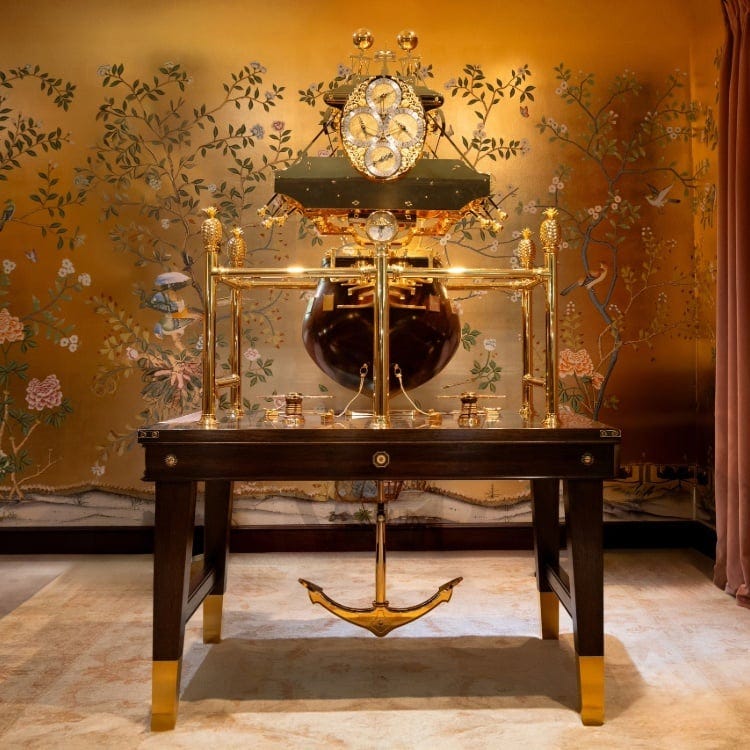
Enter Charlie Pragnell, the sixth-generation independent retailer whose flagship on Mayfair’s Mount Street is one of the country’s leading high-end watch destinations and in recent years one of the few remaining in London to actually offer bricks and mortar space for top indie brands (it also stocks Rolex, Patek, and the majority of Richemont and LVMH brands). Pragnell shares Bray’s fascination with Harrison and had a long-held desire to put the spotlight on Britain’s historical contributions to the world of watchmaking. In March 2022 the two men decided to take on the challenge of recreating the H1. The result was the Pragnell Bray Origins Clock, named in honour of Harrison’s foundational contribution to modern timekeeping. It took six years to finish and even if you know absolutely nothing of watches or clocks whatsoever, one look at it is enough to tell you that you are in the presence of something impressive.
