

The Fourth Wheel, Issue 16
Run down to the shop at the corner and fetch me a long weight

Hello and welcome to The Fourth Wheel. I say welcome, because in the immortal words of Mr Brad Pitt, I look around, I look around and I see a lot of new faces. I have Tony Traina at Rescapement to thank for that - it’s a huge compliment to be recommended by a much bigger and more established publication, and I appreciate it. Unlike Tyler Durden, I am happy for you to talk about The Fourth Wheel - in fact, I actively encourage it. If you like what I’m doing here it would mean so much if you can spare a minute to share it. And if you have any questions, this is the place. Now, on with the show!
Earlier this month I had the privilege of a visit to Cartier London’s archive. Housed on the top floor of its New Bond St flagship, this is a rarely seen trove of information and historical records. Themed visits are occasionally arranged for top, top clients, but outside of that it’s only a handful of journalists like myself who get access. Which is a shame, really because it was absolutely fascinating. I visited with my opposite number at Net-a-Porter, Watches and Jewellery Editor Charlie Boyd, and we were treated to a whirlwind run through Cartier history from the founding of the London ‘temple’, as it’s sometimes referred to, in 1909 up until the 1960s.
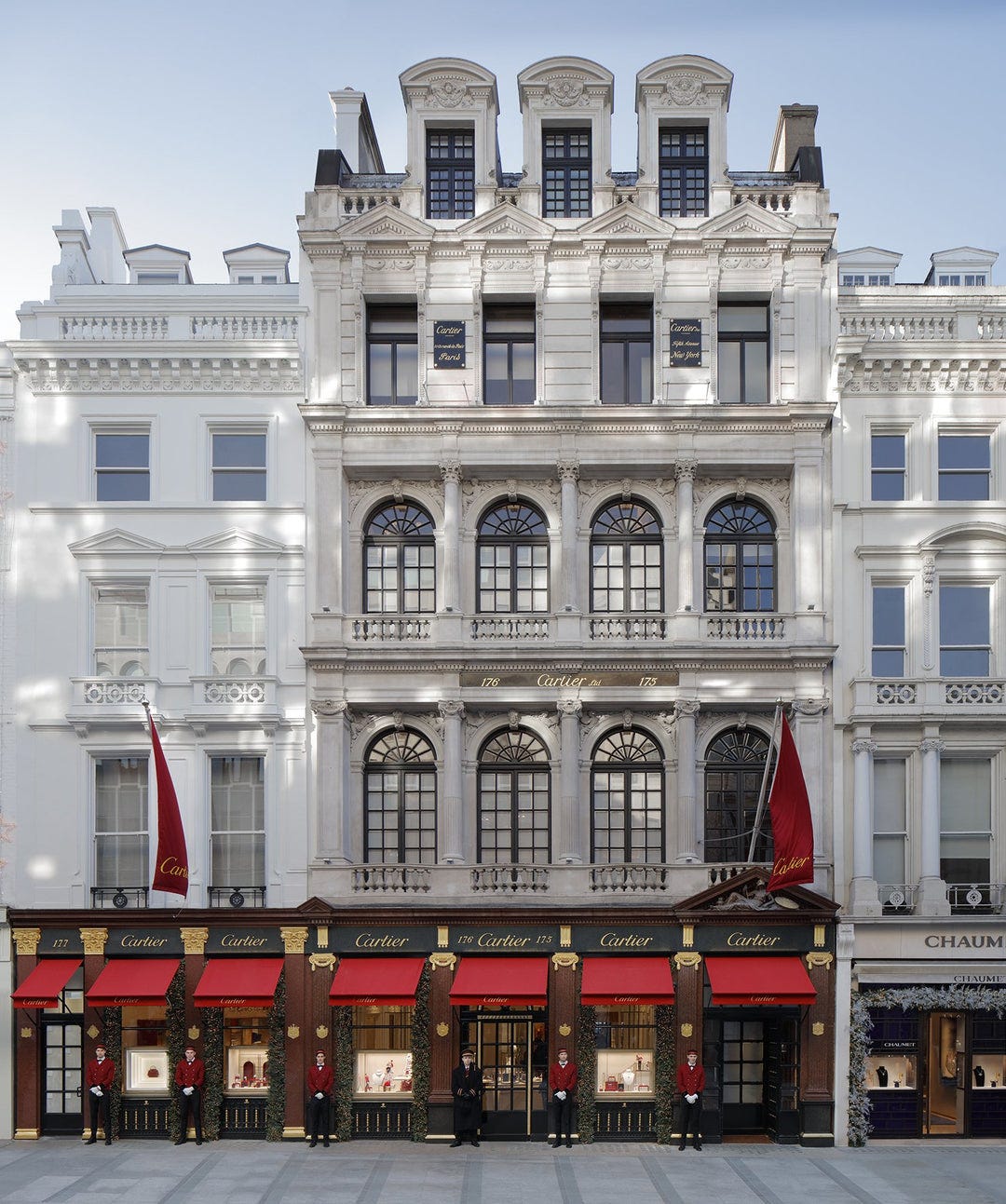
We weren’t allowed to take photos, which is pretty standard for this kind of thing, but I thought I’d just share a few of the titbits I picked up. Cartier is having such a boom year that it felt like just the right time to reacquaint ourselves with its history, and head archivist Jenny Rourke was an outstanding guide through the decades of craft and social history that are preserved in weighty green leather-bound books as well as dozens of poster-sized boxes, each filled with 1:1 sketches and photographs of the workshop’s creations - but also correspondence, period advertising, sales ledgers, you name it. In no particular order, these are some of the insights I gleaned.
Cartier nearly set up in St Petersburg instead of New York, but it was felt that the US city was sufficiently up-and-coming to be worth a shot. I’d say that decision worked out reasonably well.
It’s all very well trotting out the line about being ‘the jeweller of kings’ but when you actually see names like Mountbatten in the order book and read letters from the Queen Mother, it brings it home.
Marketing nous was alive and well a hundred years ago; Cartier called its London workshop ‘English Artworks’ to make it more appealing to the local aristocracy. And manager Jacques Cartier was quick to realise the value of making outlandish, enormous creations - mostly jewelled headgear - for the ‘it girls’ of the day to wear in society. We look back now and think it’s all so elegant, but it was the over-the-top influencer flexing of its day.
The sheer creativity on display was phenomenal. Not being a jewellery writer, I had never fully appreciated how bespoke the business was in the pre-war period. Practically everything was a one-off, and the 20-30 craftsmen on the second floor turned out a remarkable volume of pieces. And they had to work from two-dimensional sketches, sometimes only showing one angle, and interpret that into a 3D, practical, wearable item.
Cartier London had its own in-house photographer and studio at a time when that must have been a significant luxury. It was still the hand-drawn sketches that really wowed, though - even the formulaic records are works of art in their own right.
Attending watch fairs and reading press coverage year after year, you can start to wonder how many vintage pieces can possibly still be left waiting to be reissued. But one look inside a brand’s archive and you realise the answer is: a lot. We saw photos of Cartier watches I’ve never ever seen at auction or in any brand history. A personal favourite was a round-cased watch with a 24-hour dial laid out in a black and white interlocking spiral shape; almost psychedelic.
We think of Cartier design and we think Roman numerals, railroad minute tracks and unusual case shapes. But there were SO many Cartier designs that didn’t follow this format. Some - many, I think - were Cartier-signed watches made by the likes of Universal, Longines, Omega and probably many other now-defunct names.1 Others looked at a glance like Cartier’s own creations. We saw - and were able to handle - a box full of dial design sketches, crudely drawn out on scraps of cardboard. The variety struck me: several you could immediately point out as Tank variants, but there were arrowhead hour markers, submariner-style circular pots with a triangle at 12, and many other completely un-Cartier dials. I don’t know if many of these were ever made. Some were for clocks, I believe, where you will find a bit more deviation from the wristwatch design language, and others probably never saw the light of day.
To summarise the last two points: the volumes were certainly small, but there is a lot of vintage Cartier that just hasn’t come to light yet, or isn’t widely known. I wouldn’t be at all surprised if the big auction houses are prepping some dedicated Cartier sales - now is certainly the time. I also know that Auro Montanari is working on a new book about the history of Cartier London, which may shed more light.
If you want to read more about Cartier history, there are plenty of good articles out there. I recommend James Dowling’s history of the Tank for QP, which I edited, but also this piece at A Collected Man, and Hodinkee’s visits to the Geneva museum (where Cartier keeps its actual watches) and New York mansion. There’s also Tony Traina - him again! - on the Cartier Crash.
A note on last week’s issue: I wrote of Robin Swithinbank’s story in the NYT about waiting lists that I would have expected the paper’s editors to check whether Zenith Chronomaster Sports were actually available to buy, while quoting CEO Julien Tornare’s claim that it had become a waiting list watch. It was a throwaway line; my main interest was in a blog by an economist called Brendan Cunningham which was much (much!) more outspoken - Cunningham basically called bullshit on the reporting by Bloomberg, the NYT and anyone else making the same claim. You can read what I said here, but it was brought to my attention that I might not have been entirely fair on the NYT. As luck would have it, I spoke to Zenith CEO Julien Tornare myself this week, so I thought I’d take the chance to set the record straight and get to the bottom of this whole ‘waiting list’ morass.
A key part of Cunningham’s argument was that the Chronomaster Sport was actually available on retailers’ websites to add to basket, and therefore it couldn’t actually be a waiting list watch. I found the same myself at Watches of Switzerland and at the time of writing now (Thursday 18th) you can add the Chronomaster Sport to basket on Zenith’s own website. My mistake - and Cunningham’s - was to assume this meant a watch was in stock and ready to ship, thus exploding the idea of a waiting list. I asked Tornare directly if this was the case and he said that no, it wasn’t. He explained that once payment was taken, you would be informed how long it would be until your watch was delivered, and said that depending on the retailer and the timing of stock shipments, it could be several weeks or a few months. You can argue whether this is the same as a boutique/AD waiting list in the traditional sense - I’m not sure if it’s the same everywhere, but my understanding is that in a store you don’t have to pay up front (or not in full) - but if the question is “do you have to wait potentially several months to receive a Chronomaster Sport?” then the answer is: yes. You might also ask whether better communication is needed; I went as far through the checkout process as I could without actually spending £9,200 that I don't have and there's nothing to say 'you'll be waiting a while to get this watch'. But that's another conversation.2
It’s also possible the Chronomaster Sport was out of stock completely at the time the NYT or Bloomberg stories were filed or published, and stock landed at retailers around the world in the intervening couple of weeks. I think given the CS’s widespread ‘add-to-basket’ availability now, this is unlikely, but not impossible. Tornare himself said that shipments are going out periodically, so even if you are taking this as a metric of true availability, it makes fact-checking nigh-on impossible. The reality, though, is that very often in the watch world, checking or corroborating statements from CEOs and executives is very hard; together with anecdotal evidence from customers and off-the-record briefings from retailers you can build up a truly clear picture, but that’s not the same thing, and not a copy-editor or sub-editor’s job.
I think it’s worth remembering that although ‘X is now a wait-list watch’ constituted a news story for Bloomberg (it wasn’t the entire thrust of the NYT piece, by a long way), and that ‘wait list status’ might make people look differently at Zenith, waiting lists are no-one’s favourite thing. Tornare was, and has been in the past, clear that he doesn’t enjoy the situation and certainly hasn’t engineered it for any perception of desirability. We as watch enthusiasts don’t want to have to wait to buy our favourite watches; it shouldn’t be a badge of honour. It’s bad enough that waiting lists have become accepted as the norm for Rolex - we don’t want to head towards a market where that’s expected for non-limited, core collection pieces like the Chronomaster Sport, Speedmaster, IWC Pilot’s chronograph, and so on. I think that’s something we all agree on.
Quick Links
Jack Forster Named Global Editorial Director at WatchBox
This will feel like the end of an era for many; Jack has written some outstanding (and extremely in-depth) stories at Hodinkee and leaves huge shoes to fill. Will be interesting to see how he changes things at WatchBox.‘90s Week at Hodinkee
The 1990s are coming back. Don’t just take my word for it (although, cough, I did get there a few weeks ago ;-) ). Hodinkee has pulled together a week’s worth of Nineties stories and I’m here for it: I think the 1990s has been much maligned as a decade and is well worth more of our attention not just in terms of the watches made but because it’s the decade in which the modern industry was really forged. There are fun stories at Hodinkee, from a fantastic trio of George Daniels watches coming up for sale to a platinum Swatch.Rolex To Open Three-Storey Flagship On Bond St, at WatchPro
“Perhaps getting ahead of questions about opening a vast Rolex showroom at a time when it is almost impossible for new customers to buy its watches, WoSG says that the flagship will focus on client hospitality and the history of Rolex.”
So, yeah… that’s a lot of space to not sell any watches in. Must be nice, as they say.My Three Watch Wardrobe: Singapore Watch Club Founder Tom Chng, at Mr Porter
I’m back in self-promotion-corner with an interview with Tom Chng of @singaporewatchclub. I massively enjoy the variety of these stories; no two collectors are the same. This story takes in a little financial crime too, which was an eye-opener.A. Lange & Sohne’s One-Off Chronograph For The Concours d’Elegance, at RobbReport
People often ask me what I’d buy, money no object. This just went right to the top of the list. Might have to settle for this instead though…A Moment That Changed Me… at the Guardian
Via Mat Craddock (@the_watchnerd on Instagram), this isn’t really a story about watches but it is a story in which a watch saves lives. And no, it’s not a Breitling Emergency.
And finally…
I don’t know who Watches of Espionage is - he just popped into existence a few months ago - but apparently there’s a newsletter on the way.
This kind of thing doesn’t leak out very often - if it’s genuine, of course. Wouldn’t want to be the Lange & Sohne boutique assistant fielding questions from irritated clients brandishing a copy…
Sylvester Stallone isn’t just associated with Panerai, he’s often credited with singlehandedly propelling it into the limelight (the Daylight, perhaps). The full story is, actually, fascinating. But beyond this association, Stallone is actually a major collector across a number of brands. I saw a video posted by George Glasgow Jr (who makes Sly’s shoes) the other day and caught a flash of gold on his wrist. Imagine my surprise to find not a Panerai, nor a Daytona or Patek, but an original Piaget Polo.
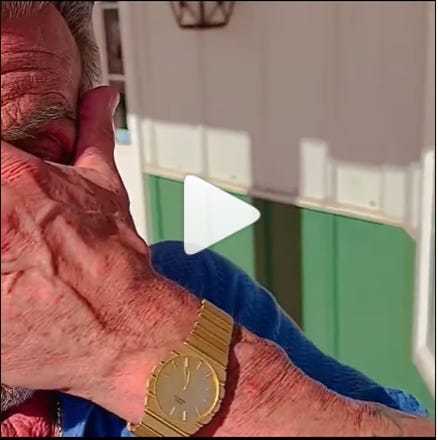
So you’ve got a well-built, in-your-face icon of excess that was arguably at its best in the 1980s… and Sylvester Stallone.
Not double-signed, just Cartier signed, ‘white label’ watches from the Swiss makers. Chronographs, calendars, dress watches, you name it. We only saw a dozen or so photo sheets from one box out of many…
For what it’s worth, and I don’t mean to imply we’re better than others, but at Mr Porter if you can pop it in your basket, you can buy it and it will start making its way to you as soon as possible. Watches still sometimes take a while to ship but that’s order processing, shipping, customs, etc - we’re not waiting for the stock to reach us before sending it on. But everyone does it differently.