

The Fourth Wheel, Issue 17
To kowtow, or not to kowtow - that is the question

Hello everyone. Hope you’re all having a good week! Little bit of housekeeping first of all: the Fourth Wheel will be having a week off next week, as I’m taking a much-needed holiday. Meanwhile, anyone else whose mind runs at 28,800vph1 will be glued to - or attending - Geneva Watch Days: I’m hoping that by absconding at the same time I can let everyone binge on the shiny new launches and then when it’s all calmed down the week after I’ll have had time to figure out what’s truly interesting. See you in two weeks :-)
Rob Corder, co-founder and managing editor of WatchPro, writes a fairly opinionated column and last week, took a bit of a swing at other watch journalists. He writes:
“…the vast majority of journalists and editors kowtow to the brands for fear of losing advertising or access to luxurious trips and other jollies.
This strikes me as bizarre, particularly since the brands have cut advertising to levels that would barely support a part time blogger, let alone a serious editorial team.
[…]
With the exception of WATCHPRO, traditional watch media continues to fight for survival using 20th century weapons; lavishing brands with sycophantic praise, but gaining nothing in return.
Worse, consumers have learned to ignore content so obviously created to serve brands rather than viewers, listeners and readers, so they move on.
I’m proud of the independence we’ve maintained at WATCHPRO, and our unswerving mission to tell it as we see it, regardless of who it bothers.
We are 11 years-old, read by around one million people per month, maintain a full time team of six amazing people and a virtual team of the best writers on the planet.
And we have come this far with barely a penny from the biggest brands: Rolex, Cartier, Omega and the like.
The reality is we have offended all of these brands so often that they no longer take offence.”
I like and respect Rob; I think he’s done a great job at WatchPro in the last few years, and he’s a smart guy who understands the media and the watch business. I’m pretty sure therefore that he knows that what he’s saying isn’t that fair - sometimes, when it’s a slow summer week, you’ve got to stir things up a little to get people clicking.
So why am I taking the bait? Because when you pull at this thread, it’s a question I’ve been fielding all my professional life. Because it’s there in the Hodinkee comments and all over social media. And because I feel well placed, after 13 years as a journalist including six at QP Magazine, to say something about editorial integrity and the business of writing about watches in print and online.
Rob is right to observe that watch brands have cut their print advertising spend by a huge amount over the last decade. So have practically all other potential advertisers. In fact, the watch brands have been comparatively longstanding in their support - but as Rob says, it’s impossible to ignore that the media marketplace has changed enormously. Budgets once destined for glossy pages headed instead towards influencers and digital advertising (which costs a fraction of print for far greater reach). I’ve heard plenty of people at watch brands privately question whether spending all that money on influencers was really worth it, but that’s a story for another day. Global economic trends also play their part: when the industry faced a sharp correction over the downturn in Chinese business, a lot of advertising budgets were slashed. When sales rebounded, those budgets never returned. It’s always the same: pandemics, recessions - all have left their mark.
Magazines and newspapers used to make their money from sales - i.e. the newsstand/cover price, and subscribers. During the 80s, 90s and 00s, advertising became the primary source of revenue. When Facebook and Google took that away, publishers faced a downward spiral: a race to the bottom to win back advertising at any cost. Undercut the competition. Strike ever-more generous deals. Give a free page away in return for the promise of future ads at full rate.2 The unwritten link between advertising and (implicitly favourable) coverage became stronger; advertisers got bolder in their demands for a quid pro quo. Where once you paid for advertising and got... advertising... now you pay for advertising and you get editorial. Advertising execs were forced to get more creative in terms of what they could offer, selling formats and concepts that ate into the 'content', i.e. the thing readers were really after in the first place. We saw the rise of the advertorial, or sponsored feature. At the same time, the digital giants were also taking away your readers, and it didn't matter if you took your print journalism online in a bid to compete; the economics of digital display advertising meant that revenues were tiny; you're still paying the writer the same rate3 for the story but making pennies on the pound in terms of what you've sold against it, and you're reliant on the algorithms of the same companies that have hoovered up your revenue and your readers if you want to see any traffic. Hence: cheaper and trashier journalism, and in greater amounts, to chase the same diminishing returns.
Things have changed a little bit in the last 3-4 years - more and more magazines have realised it’s untenable to give their work away for free, and more readers are content to pay for something that’s actually worth reading. But there isn’t a profitable media business on the planet that hasn’t also had to diversify its revenues into other areas. WatchPro is no different - it has a strong and growing line-up of events and an annual awards do.
There are still print titles (just about, in some cases), but a lot of them exist as the ‘halo’ product atop a business model that relies on any number of other ways to make money out of its readers. These print titles still carry advertising, and equally there isn’t an editor who isn’t mindful of where the money is coming from. For example, the August issue of WatchPro carries seven adverts - including the front cover image itself - which according to the rate card, are worth between £38,000 and £45,000 in total. No magazine, in my experience, sells every ad at rate card prices, but it’s a useful ballpark figure; that’s revenue you can’t afford to ignore. Rob Corder isn’t lying when he says WatchPro has got up the noses of some of the biggest brands - usually by pulling financial info from Companies House filings, that kind of thing. Actual journalism! But if you’re telling me you’re going to sell Baume & Mercier the cover and then give them both barrels on page nine, I’ll eat my shoe. The picture is different at every title, and the media culture varies around the world - I’m most familiar with UK media, whereas US titles have historically been better able to assert their independence, i.e. better funded - but the basic truth is the same. No-one bites the hand that feeds.
But to get back to the point. Do editors kowtow to brands? Do writers lavish sycophantic praise, getting nothing in return? Is there such a thing as journalistic integrity in the luxury watch world?
I’ve written for every broadsheet newspaper that covers watches in this country, and most of the magazines. I’ve been asked to include certain brands because they advertise, sometimes. No writer hasn’t. But if the brand in question doesn't work for the story, I've said so and found a way around it; nine times out of ten, what you're asked to include is what you'd naturally need to include anyway. I’m always trying to write a story that genuinely informs people - that educates and entertains them. Good journalists, and good titles, don’t re-hash press releases or write slavishly positive coverage that wouldn’t stand up to scrutiny. Sometimes it can look like there’s a conflict of interest when there really wasn’t one: if, say, Tudor releases a new Black Bay, and you run a watch publication, you’ll want to write about it. Quite separately (which is the key) your ad sales manager will be trying to get Tudor into the issue. Their ad campaign will feature the newest model which, surprise surprise, is the one you’ve just written about. The number of times this happened on QP - we’d put the book together, often only a few days before going to press, and this would be the first time you’d see the advertising that would get in between your precious layouts. And frequently we’d shake our heads in despair that the ads booked were too closely aligned to our content, knowing full well what it looked like for our credibility.4 Mainstream media has the advantage of drawing on a wide pool of advertisers so it can afford to offend some, from time to time. In a specialist world like watches, it’s much harder.
For all of the reasons above, plus a few more, the balance of power is skewed towards the brands. If your revenue depends on them - for advertising, or for their commitment to live events, or other sponsorships - you cannot afford to alienate them. Industry magazines have a stronger subscriber base, but it still applies. Unlike thirty years ago, or more, there are no publications that are so essential that an advertiser will feel they need to be present in their pages, regardless of the tone of the coverage. If noses are out of joint, there are plenty of other ways to spend that advertising budget. And the truth is, the watch industry isn’t like, say, the car industry, where a bad review won’t exactly be welcomed, but it will usually be taken on the chin. Noses are easily disjointed, and to an extent, I think Rob is pointing the finger in the wrong direction here. I used to get asked about ‘reviewing’ watches a lot5 and fell back on the same logic a lot of the time: if a watch isn't great, you'll find it just doesn't get reviewed at all. It's not just "traditional watch media" that works this way either; most watch websites are far more interested in telling you what's good than what isn't.
As I sit here, I think the only place you can say exactly whatever you like about watches and make money is probably YouTube. Even there, if you want your voice to be taken seriously, you've got to establish your credentials for passing judgement - which brings us back to magazines. Social media may have given everyone a platform but there is still a need for entities that nurture and collate expertise, and convey that to consumers in a professional manner. They may not always be printed on paper but I believe they will always exist, and as long as they do we will probably be having conversations about their integrity. Which is as it should be - a critical audience is vital. Could the situation be better? Undoubtedly. Could 'legacy' media have made a stand at some point in the last ten years, an attempt to re-cast the balance of power and assert its freedom from influence? It's a nice idea. At some point in his or her life, every editor fantasises about telling their advertisers/publishers where to shove it and doing exactly what they want, but unless you’ve got deep commercial backing that will subsidise that kind of stance, it’s not a viable option. The cold truth is that good quality journalism, especially in print, costs a lot more than people are prepared to pay for it. As it stands, I think we all - every one of us - have to accept the industry's imperfections, and remember that we're all playing by the same rules.
Quick Links
The Wisdom Of David Duggan, at WatchPro
“I used to have a sports bag packed with a box of diamond rings, a few watches and £5,000 in cash. An old friend told me that I should always have a squash racquet sticking out of the bag, so I did. I think that racquet must have saved my bacon many a time – and I have still never played a game of squash in my life.”
This is a proper ramble down memory lane, in the best possible way. David Duggan has been selling watches since the 1980s and has quite literally seen it all. He talks to Tracey Llewellyn about missed opportunities, making £2m on an Asprey-signed 2499, and selling Cartier to Cilla Black. (And the bygone power of print advertising! Duggan was one of the longest-running and most loyal advertisers in QP, until eventually giving it up in about 2017.)EBay Takes A Major Step Forward With Jewellery Authentication, at Europa Star
“first introduced to the US market in September 2020, the Authenticity Guarantee service for watches has now been extended to the United Kingdom and Germany, for timepieces sold at £2,000 and above.”
Forgive the dull headline - it’s ‘partner content’ after all. The point here is that eBay is coming for luxury goods in a big way. It’s the sleeping giant, and having opened a watch service centre, started authentication programmes, and introduced escrow payments, it’s waking up. I’ve been speaking to a few brands about the secondary market recently and more than one has suggested that it would make sense to partner up with eBay for a ‘drop’ rather than see flippers using the platform to make a profit. It will happen at some point, and I can see eBay becoming an approved retailer for low to mid-level brands in the not too distant future. Whether it can rival Chrono24 for a smooth experience remains to be seen - but with around 175m users, it’s got size on its side.Graduation Day: A Complete Newbie Becomes A Watch Writer, at Hodinkee
“I estimate that 40 percent of being a watch writer is a willingness to put on a white coat, another 40 percent is a willingness to let other nerds photograph you in white coats, and the remaining 20 is listening to people”
I’ve really enjoyed Sarah Miller’s columns for Hodinkee. She’s a pithy, self-deprecating, quotable writer who’s been able to come at the world of watches with a fine balance of wry cynicism, naivety and eagerness to learn. There’s just something fun about having the world you inhabit observed from without: a lot of the nonsense we take for granted, Sarah sees for what it is. As she joins Hodinkee full time, I wonder what’s going to happen to the ‘newbie’ POV, but she has a writing style that’s quite different from the rest of the team, and that’s always worth having.Can You Pair Your Watch And Sneakers? Yes, Here’s How, at Mr Porter
It’s not all serious teardowns of the detent escapement or theses on the importance of the Jaeger-LeCoultre Calibre 920, you know. Admittedly, at Mr Porter it is never these things, but I’m more than ok with that. My ex-colleague Finlay Renwick wrote a fun, silly, ‘why-the-hell-not’ piece on which sneakers go with which watches, and sometimes that’s exactly what you need.
And finally…
I went down a massive wormhole of 1990s watches this week. It didn’t take much - an Instagram message from Justin Hast when I was supposed to be writing something quite urgently was enough to spin me off for a good 45 minutes on Chrono24. Keeping my budget tight, I didn’t expect to find too much good stuff, but holy shit, if you just want to own a chronograph from a decent brand, the 90s are your friend.
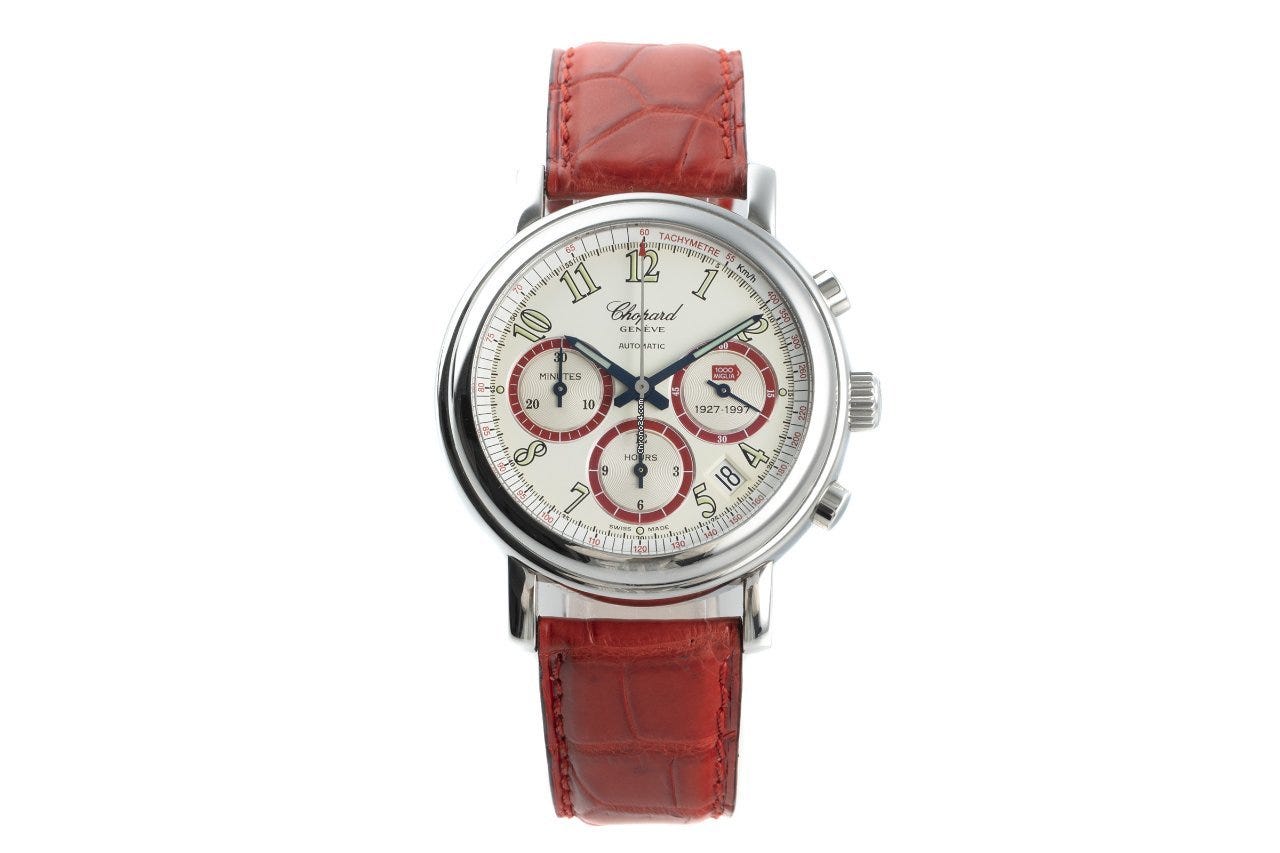
I’m quite tempted by this Chopard Mille Miglia from 1997, or this IWC GST in steel from 1999. Lower your sights even more and tell me this Eberhard isn’t a snip at $1500. Or this officer caseback handwound oddball for $1700. It went on; beyond chronographs, I lingered on Girard-Perregaux Ferrari watches (I swear these will bubble up at some point), funky dive watches, Alain Silberstein and a really cool Gerald Genta quartz GMT. The biggest lure is Porsche Design, however. I firmly believe you could come back in a year and these will be worth a lot more. This is just fantastic, for less than $2000. Somebody stop me…
This has given me a great idea for a run of super-nerdy watch based insults. “He’s a three hertz mind in a high-beat chronograph body”; “About as useful as a date ring underwater”; “All machine polish and no internal angles”, that sort of thing.
Promises that were not always fulfilled, you’ll be shocked - shocked! - to hear.
We can save my rant about the stagnant rates of freelance journalism pay for another time
What’s more useful is to look at how often a publication covers brands that never advertise; good magazines always do.
If you read QP magazine at the time, you’d see that we actually were often happy to point out shortcomings of watches, but that’s by the by.
I really enjoy reading your articles. It’s good to read a well-reasoned argument and to explain matters so clearly.