

The Fourth Wheel, Issue 5
Picking the crumbs off the space marketing cake

This week Breitling held a press conference in Zurich to announce the launch of a new Navitimer Cosmonaute limited edition. It marked 60 years to the day since astronaut Scott Carpenter orbited the earth three times wearing a Navitimer Cosmonaute - a moment Breitling has claimed ever since as the first time a Swiss wristwatch was worn in space.
The watch itself isn’t my interest here (it’s a 24-hour Navitimer, with a really decent movement - that’s my review). Reading various stories about it, mostly by Jeff Stein of On The Dash, sent me off down a rabbit hole and got me thinking about how brands exploit, or ignore, their history .
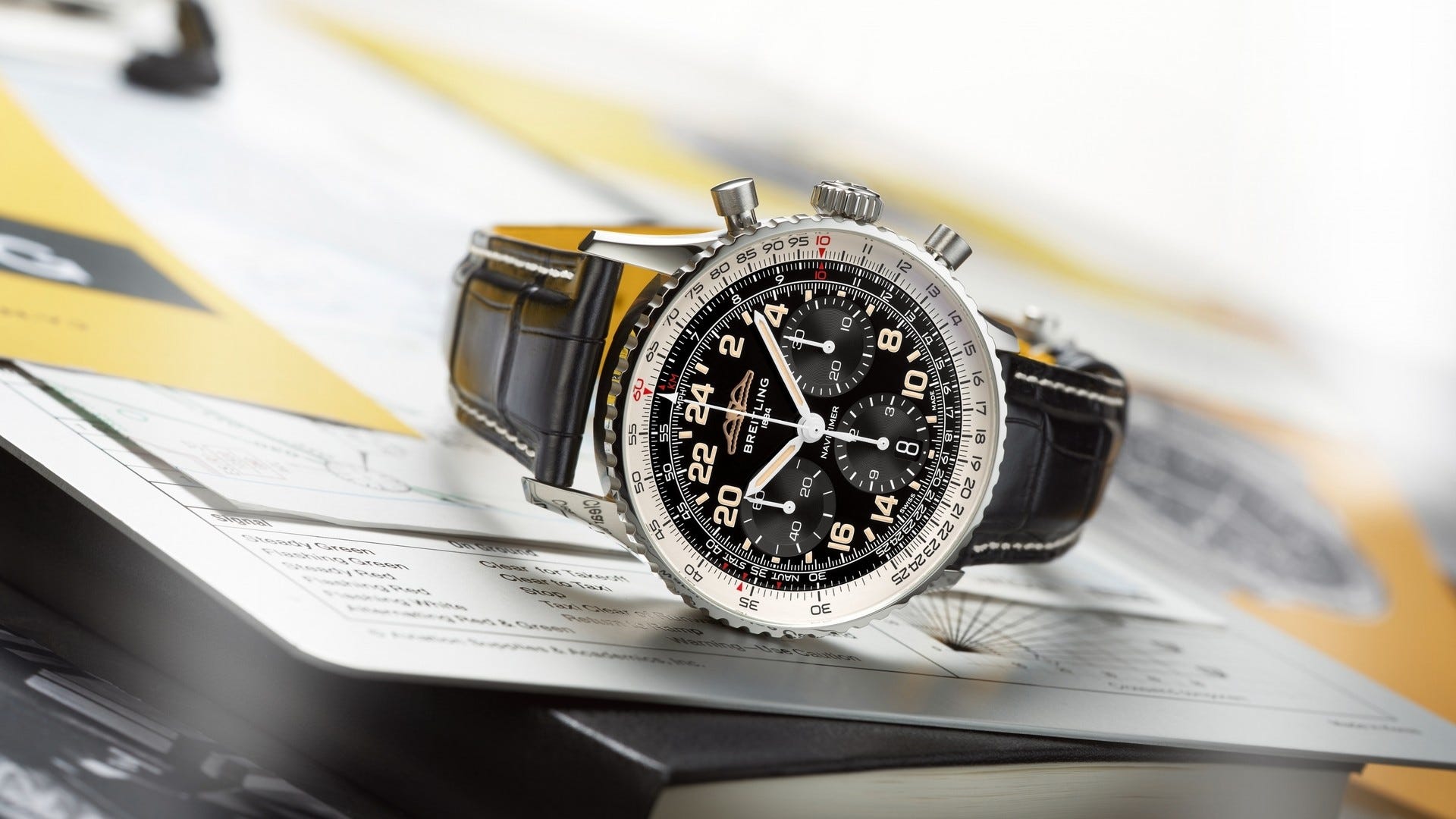
The new Navitimer 41 Cosmonaute
When you think about watches in space, you think about Omega. Getting the Speedmaster approved by NASA was such a massive stroke of luck - more often than not it is luck; it was for Breitling too - that you cannot begrudge Omega marketing the hell out of it. No-one else would do anything different. When it comes to space watches, Omega has the cake, the plate, the icing and the cherry on top - everyone else gets crumbs.
Breitling’s claim is one of the bigger crumbs available; it has the advantage of being a ‘first’, and we know the watch world LOVES a first. But it’s a heavily qualified first. Carpenter wasn’t the first man in space, the first American in space or the first man to orbit the earth, and his watch wasn’t the first watch in space1. Gagarin wore a Russian-made Shturmanskie and John Glenn, who preceded Carpenter by one and was the first man to orbit the earth, wore a Heuer stopwatch in a makeshift wrist-pouch. Hence ‘first Swiss wristwatch’ in space.
This is not to take shots at Breitling for celebrating the anniversary. Being involved in the early forays beyond this planet in any way is irreplaceably significant, and the fact that Carpenter loved watches, specifically requested the Cosmonaute from Breitling and that its use on his flight led to all astronauts on the Mercury programme receiving one from Breitling adds extra weight. (It is amusing that it ended up named along more Soviet lines, presumably because Bulova already had the Accutron Astronaut. You wonder about the all-American heroes that were the Mercury 7, all military veterans, receiving their Breitlings and realising that it sounds like it’s named for their bitter Cold War rivals.)
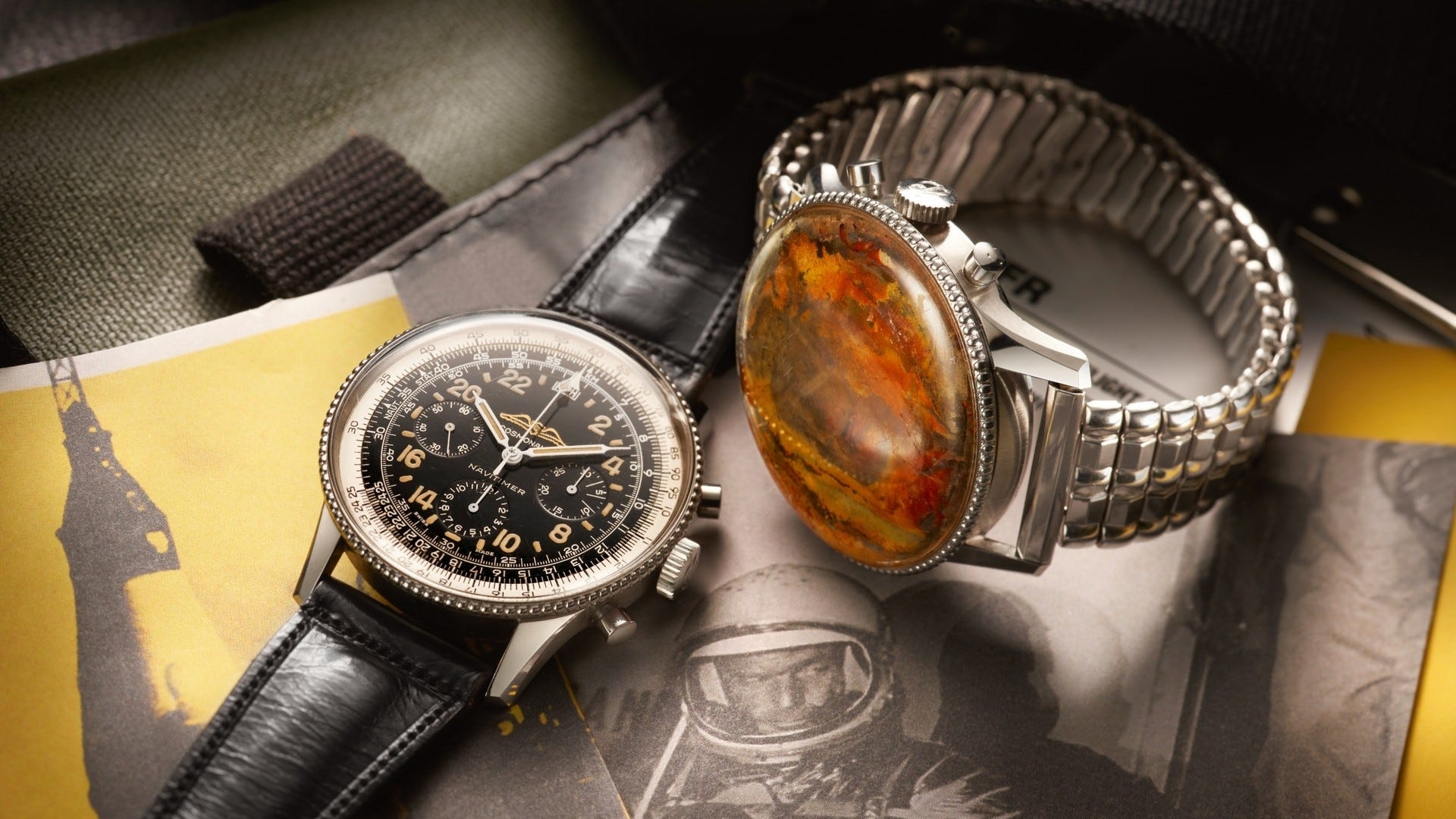
On the right, Carpenter’s actual watch, severely damaged by the hours spent in the ocean after he returned to earth
No, what I’m getting at is the path not taken by other brands. TAG Heuer could easily have glossed over the fact it was a stopwatch rather than a chronograph and made something of its moment in John Glenn’s flight, but understandably had too many other irons in the fire. In the early ‘60s Jack Heuer was focussed on motor racing and developing Calibre 11, the first automatic chronograph; those would become its marketing pillars.
The real what-if for me hinges on the fact, or assumption, that Alan Shepard and Gus Grissom, the first two Americans in space, did not wear watches on their flights. As far as I can tell this conclusion is based on a lack of photographic evidence - but it seems surprising given the photos that exist of them wearing watches everywhere but during the mission. We do know that all seven astronauts were issued with specially customised 24-hour watches made by LeCoultre2, a variant on a model called the Quartermaster, and most of them also had the aforementioned Accutron Astronaut. Bulova has had its sliver of space pie, but imagine a world in which modern-day Jaeger-LeCoultre leaned hard on its credentials as maker of the ‘first Swiss watch in space’. According to the invaluable resource that is the Watches Used In Space Exploration database, these LeCoultre watches never left the earth’s gravity. But what if it was just underneath Shepard’s suit and he never mentioned it? Who can say.
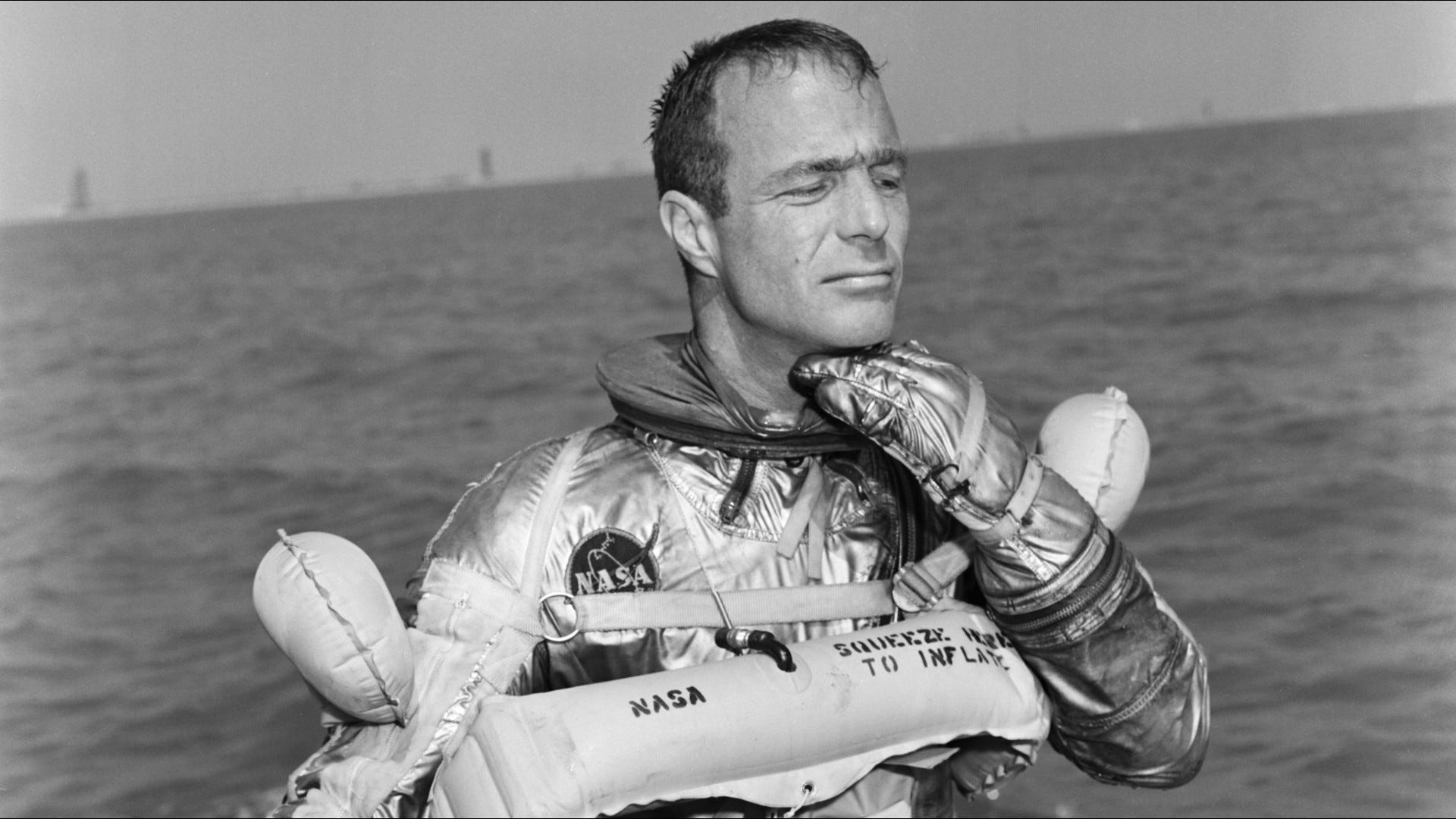
Scott Carpenter, looking square-jawed and a tough disgruntled on splashdown
Partly it comes down to luck. Partly it’s about what kind of brand you want to be. And partly it’s about record-keeping. I read an unsubstantiated claim that modern-day Jaeger-LeCoultre is missing a fair bit of the LeCoultre archive, which wouldn’t help. Regardless, there is enough known activity from both Jaeger and LeCoultre individually and together that if JLC wanted to re-cast itself in the racing-flying-exploring-fighting mould, the heritage is all there. By the same token, Vacheron Constantin makes very little of its role providing timing equipment for Donald Campbell’s water speed record runs and Girard-Perregaux isn’t often found talking about its grid-dialled officer’s watch from 1880 which gives it a decent claim as the first maker of wristwatches, full stop. If you run a watch brand today, arguably the most important part of your job is managing your heritage, and getting it right for today’s market is as much about what you leave out as what you keep in.
Quick Links
Submissions now open for the Watch Annual 2022
The Watch Annual, entering its third year of production, seems to be adopting a different approach: you can now fill out a form to submit any watch you like for inclusion. I’ve no idea how Justin intends to edit them down but having contributed to last year’s annual (I picked another Breitling chronograph, funnily enough) and played my small part in creating the Mr Porter special edition, I’ve got a soft spot for this publishing start-up.Tom Cruise still doesn’t get a Top Gun watch, at Monochrome
It’s a quirk of the marketing universe that despite IWC’s long-standing association with the actual Top Gun pilot’s school, it has no official relationship with the movie franchise that has made said school famous around the world. So, Tom ‘flys-his-own-P51’ Cruise doesn’t get the latest Pilot’s Chronograph from Schaffhausen: instead, a Porsche Design chrono to match the one he wore in the original. There are, apparently, IWC watches on some of the other actors’ wrists though.The Heritage Bicompax Hometown Edition, from Carl. F. Bucherer
On behalf of all Londoners, especially right now, can I ask that we are represented in the niche world of ‘cityscape engraved watches’ by something - anything - other than the houses of Parliament? We’re not short on landmarks, so go on, do us a favour.Taking Watches into Tough Places, at Mr Porter
“When you’re in a volcano, everything metal corrodes in no time. Sulphur dioxide in the atmosphere gets wet, creates sulphuric acid and destroys your kit. I had my MBIII on for three weeks and it’s one of the only bits of kit that didn’t get trashed”
Not quite self-promotion corner this week, as I bring you Tim Barber’s latest contribution to the Mr Porter Journal - a trio of interviews with brand ambassadors from Bremont, Oris and Panerai. A few years ago I’d have turned my nose up but we’re not asking them for their ‘objective’ views on the watches they’re paid to wear, we’re hearing about their fairly incredible adventures, where the watches come along for the ride.What is it with watches and coffee? The latest from Singer Reimagined, at WatchPro
So you’ve done the pulsometer, tachymeter, telemeter… what’s next? Obviously, the barista scale. Right? I love Singer, I have since day one, but I wasn’t expecting this. Per the press release: “Singer Reimagined is thrilled to unveil the BARISTA scale allowing easy measurement of the extraction time for your favorite coffee style prepared with your espresso machine. Something that has not been done in the timekeeping world before.” You don’t say. Watches and coffee has definitely become a bit of A Thing in the last few years though - see Brew Watches, and there was that time George Bamford and James Thompson put actual coffee on the dial of a TAG Heuer. I like an espresso or a cappuccino as much as the next guy, but I can’t say I get it. Must all stereotypical areas of male geekdom be melded into watches? Either way, time to update our story on Italy’s contribution to horology.A dashboard clock for the EV age: QLOCKTWO partners with BMW
This is fun. More of this please.Turning the greatest collection of watches into art
As a final call-back to last week’s focus on the Oak Collection, I wanted to give a shout out to Matt Murphy, the illustrator behind the Oak Collection’s promotional artwork. It’s not always easy to depict watches in a simplified way and still retain their sense of fineness, of quality and detail, but what Matt came up with did the job nicely.@Tinyassprops on Instagram
I had discovered artist Robbie Jones before, but his account @tinyassprops came back into my feed this week and I thought it was worth a share. He makes very small things - not as small as Willard Wigan (see Fourth Wheel Issue 3) - but, you know, still impressively small. And a lot of them are watches.
And finally…
While looking for ideas to steal conducting feature research this week I came across this article in the New York Times, on horological achievements recognised by Guinness World Records. There’s some predictable stuff in there, and then right at the end, this:
“And then there is Kim Seung Do from Seoul. He ate five watches (although not the wristbands) in 1 minute, 34.07 seconds in 1998 — and still holds the record for most watches eaten.”
At first I laughed, and then I winced, and then I googled, and winced a lot more, because it turns out eating things that are not food is a recognised mental disorder, although for those that have it, oddly not fatal. There is something deeply sad about ‘entertainer’ Michel Lotito, the most famous eater of… everything, and I feel the same about Kim Seung Do now, although there is precious little information out there. I find it bizarre that he drew the line at the watch strap - likely as not, the most easily digestible part for most people. Or indeed that he stopped at five. Or, frankly, went further than one - that would have been enough, I imagine, to claim the record. But there you go.
Scott Carpenter does have one other niche horological claim: in 1963 he took a break from his NASA duties to work on the US Navy’s SEALAB saturation diving project (during which time he sustained injuries that would prevent him returning to space). This means there’s a good chance he’s the first, and surely one of very few people ever, to have worn a dive watch for its intended purpose and a ‘flown’ aerospace watch. In his aquanaut life, he’s known to have worn a Rolex Submariner 5512 and an early Rolex Sea-Dweller, and in 1965 he conducted the first conversation between the ocean floor and outer space, during the Gemini program.
Reading about this I also came across the LeCoultre ‘Lucky 13’, presented to John Glenn by the Anti-Superstition Society of Chicago. Paging George Bamford, and anyone else fascinated by rare ‘13’ watches!