

Issue 173: Should We Care About The Datejust?
Reviewing Nick Foulkes' latest volume of official Rolex history

Hello and welcome back to The Fourth Wheel, the weekly watch newsletter that has something new for you today: my first horological book review, as I give you my verdict on the second volume in Nick Foulkes’ comprehensive compendium of Rolex models.
Before we get to that: the Fourth Wheel Reader Survey will close next Thursday, October 2nd. Some of you have filled it in but I would like to make one last impassioned plea for more feedback. Thousands of you are reading this every week and I want to get a really good idea of what I can do to improve it for you. We all get pestered for stuff all the time, but sparing the 10 minutes it will take is really going to make a huge difference for me, and therefore ultimately for you too. As a reminder: one lucky winner will win a box full of high-grade watch brand merch from my personal stash, and five more will win a year’s paid subscription. You can take the survey here:
Looking to the future, I have a nice announcement for you this week. I will be moderating a panel discussion at Dubai Watch Week in November! I’m going to be sitting down with Max Busser and Kari Voutilainen - and maybe others, who knows - to talk about succession. Not the TV show, although I bet they’re both big Wambsgans fans, but the concept of ensuring a stable future for their brands. Both men represent a generation of independent brand founders who are grappling with the question of ‘what comes next’, and having covered the topic for the New York Times, I’m going to be thrilled to dig a little deeper and talk about concepts of legacy, brand-building, identity and the smooth transfer of power. I know some of you will be in Dubai that week, so please, if you have time, come and find me at 3pm on Saturday 22nd. Check the DWW website for more details.
The Fourth Wheel is a reader-supported publication with no advertising, sponsorship or commercial partnerships to influence its content. It is made possible by the generous support of its readers: if you think watch journalism could do with a voice that exists outside of the usual media dynamic, please consider taking out a paid subscription. You can start with a free trial!
Here’s a little taste of what you might have missed recently:


Watching and Wondering
You will probably have seen the news that eleven new brands will join the cavernous beige halls of Watches & Wonders next year, bringing the total number of exhibitors to 66. Chief among the new arrivals is Audemars Piguet, six years after it took its leave from SIHH. Business has not been too bad since for AP, so you have to ask what it stands to gain from rejoining the fold, especially when it’s now three times the size of SIHH. It won’t be conversations with retailers, as the brand hardly has any, and I doubt it can be for cost-cutting reasons either. I’m glad it’ll be back, but is this a climbdown? Others that left the major fairs - like Breitling, or Swatch Group - still stick to their guns. One more question for me to have in my notebook as I travel to Le Brassus on Monday.
Elsewhere H. Moser & Cie will ascend to the ranks of a full exhibitor. The brand is riding high; I thought its pieces from this year were among the most impressive at the fair, and initiatives from the ‘Passion Project’ to taking an unlikely position in F1 all point to a company with confidence. But again, I have to wonder: what does a larger booth get H. Moser other than status, and a bigger bill from the FHH? If it’s about being more visible, and by extension, investing more heavily in customer acquisition and brand awareness, isn’t there a more cost-effective way? I note no mention of Hautlence, MELB Holdings’ other brand - maybe the Doug Pitt of the sibling duo is being left behind in the Carré des Horlogers. It would be the first time the two have not appeared side by side. Frederique Constant is also being promoted to the big time, and it tells you absolutely everything that H. Moser had a snappy press release ready to go, trumpeting its own success, and that at the time of writing, FC hasn’t said a darned thing.
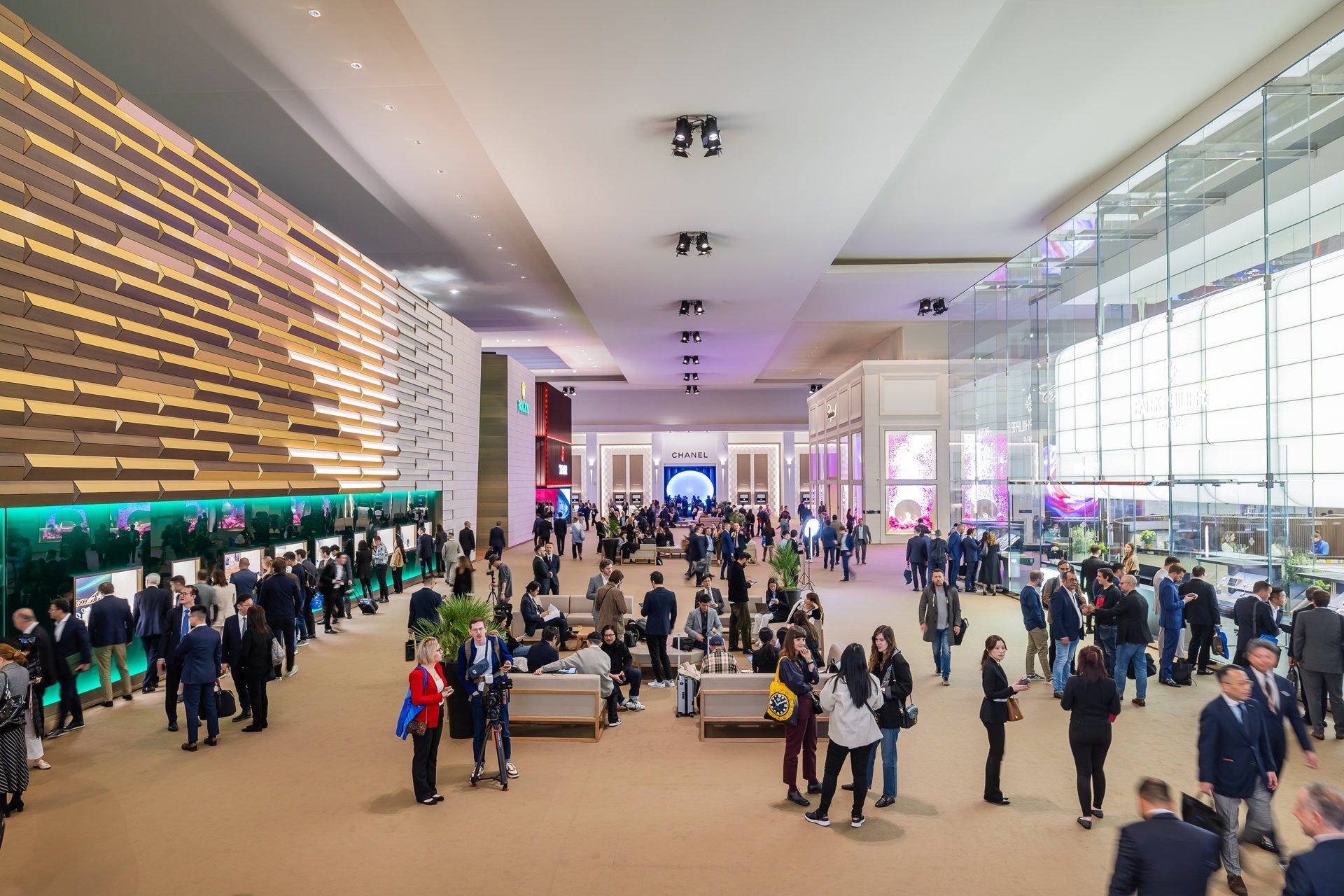
The turnover at W&W runs in both directions: as well as Audemars Piguet, we will see Behrens, Bianchet, B.R.M Chronographs, Charles Girardier, Corum, Credor, Favre Leuba, l’Epée 1839, March LA.B and Sinn Spezialuhren all arrive at Palexpo, and five existing brands make way. I’m not surprised by Favre-Leuba; they have incredibly lofty ambitions, and it’s nice to see Credor take its own stand. As others have guessed, it may mean global distribution at long last. Just as Japanese independent/artisanal high-end watchmaking really takes off, Seiko reckons the time is right to market Credor around the world; it could have had that space all to itself for the last ten years, but now that Naoya Hida, Hajime Asaoka and others are earning widespread recognition, they follow along. Baffling.
I’m interested to see Corum on that list; the management buy-out and inevitable strategic re-set must be proceeding at pace. Talking of strategic shifts, the five brands leaving the Big Brother tent are: Bell & Ross, Hysek, Meistersinger, Montblanc and Speake-Marin. I’ve contacted all five to ask why; the first four either declined to comment on the record or didn’t respond, while Speake-Marin confirmed that it had decided to step away “to focus on… journalists, clients, and partners.” Sure, because those are three groups of people in short supply at Palexpo. It will be relocating to one of the ‘pirate ship’ hotels in downtown Geneva instead and although I’m being snarky, I have to say it makes total sense. The smallest brands at W&W get the worst of all worlds, paying a high price - I mean, less than anyone else there, but it’s all relative - to compete for visibility from the worst location in the building. At some point the kudos of being present is outweighed by the practical realities. I think we’ll see a rotating door of this level of brand for a few years, until the organisers come up with a viable way of platforming ~100 or more indies under the same roof as the industry giants.
For the others leaving, well Hysek hasn’t made waves in the industry for a good decade. I’d love that to change but until it does, no big loss. Meistersinger… I mean, look, I own one, I always gave them a bit more time than they probably merited, but it really might be time to consider watches with more than one hand. Bell & Ross is an interesting one and so is Montblanc; both brands with sizeable overall production and core prices in that ‘squeezed middle’ segment. I’ve no doubt both will robustly rebut any negative implications - it’s a strategic shift. It’s always a strategic shift - but it is not the fullest endorsement of their ability to compete. Only the very largest or most unbelievably desirable brands have been able to exit the major fairs and genuinely perform better: AP, Richard Mille, maybe Breitling. Swatch Group is, well, a group, and its brands aren’t making their own choices in this context. None of B&R or Montblanc’s market rivals are going it alone like that, so let’s see.
On costs: Business of Fashion last year reported that brands pay between CHF 1,800 and CHF 2,000 per square metre for their stand. My rough estimate is that a stand like Bell & Ross is about 30m on each side, so 900 sqm. That’s a bill of between. CHF 1.6m and CHF 1.8m before you’ve staffed the stand, filled it with new artwork, expensive installations, food and drink, rented a load of screens and furniture (always extortionate) and adjusted your entire business around one massive deadline. So I can very easily understand a business thinking it can better spend a few million elsewhere. But what price do you put on the impression that you’re not part of the elite, not keeping up with the Joneses? It could be a masterstroke, if you can take that money and outflank, say, Oris, or Tudor, or TAG Heuer. But can you? Suddenly you’ve got to work twice as hard because all they had to do was show up.
Inside Number Nine
Before we proceed to the book review, I wanted to spotlight the Otsuka Lotec No.9 by Jiro Katayama, a jumping-hour tourbillon with a chiming complication. What an unusual watch! I can’t quite decide if I think it’s madness or genius; the Otsuka Lotec hype-stock is still high, but this might test the market. Really interested to see it in person; there are a lot of interesting design choices and technical solutions on display here so if nothing else, you have to salute the effort. I have to say my initial reaction on seeing this extraordinary chiming gong was that this is a man who played a lot of snake in the early 2000s.

The Watch That Made History
Can the official biography of the Datejust change its perception in the mind of modern customers?
On paper, the Datejust is not today’s entry-level Rolex; that would be the Oyster Perpetual. A steel Explorer is also less expensive, but those two have distinct personalities in today’s market that mean the Datejust is often the most attainable model in practice. The Oyster Perpetual range is populated with brightly coloured and unofficially limited editions that have taken on cult status, and the appeal of the Explorer needs no explanation. Beyond that, the Datejust’s titular feature, ergo its raison d’etre, is something that a substantial percentage of watch enthusiasts actively dislike: a date window. Obviously, as an official publication, Nick Foulkes’ book will not admit the charge - and in fact it does a fine job of showing how important the Datejust is to Rolex’s brand history - but the truth is that if books on every single model family were placed on a table, as they will be, some 10-12 years from now1, and exposed to a focus group of watch aficionados, allowed to pick their favourites, this volume would be somewhere near the bottom of the pile.
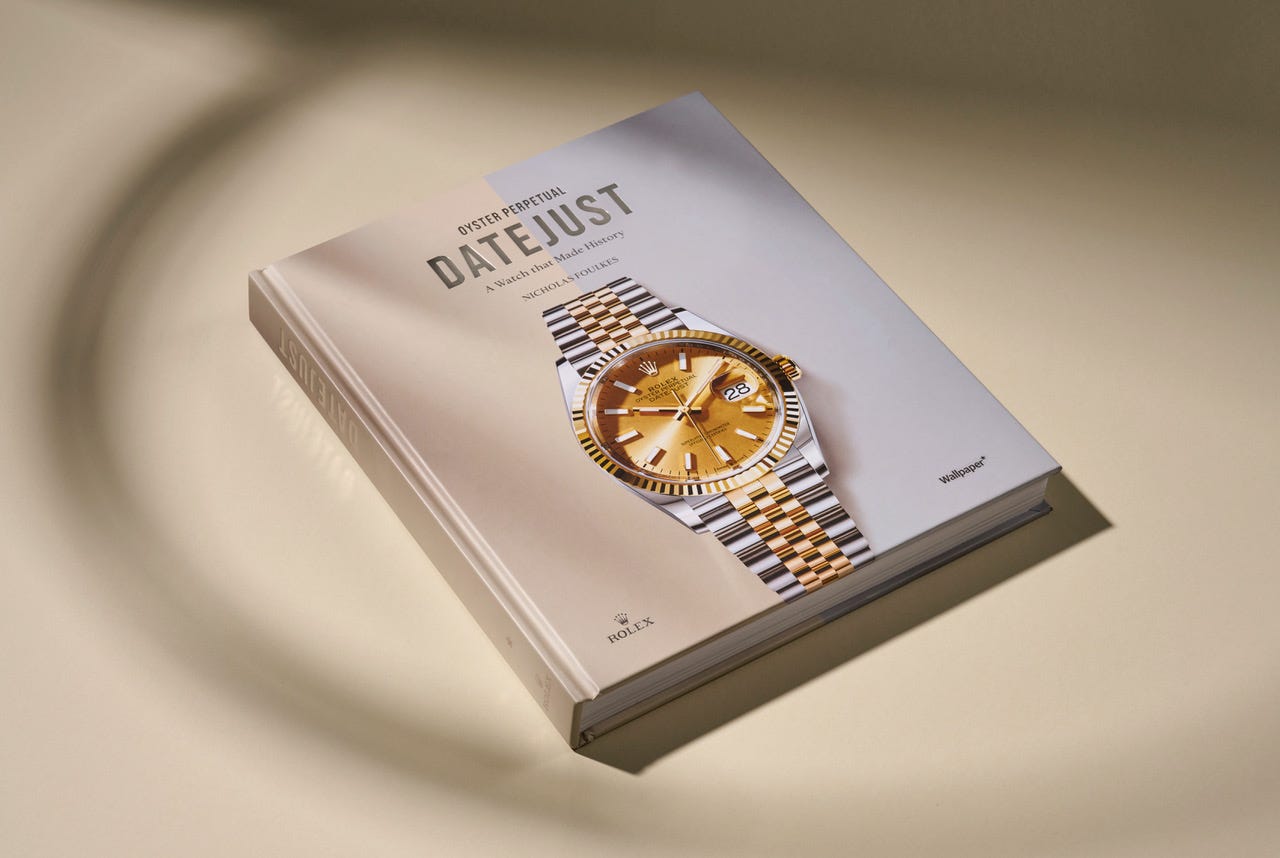
That’s no reflection on the book itself, of course. It simply interested me to reflect on why Datejust has followed Submariner; you might consider that having opened with a guaranteed banger, and knowing you’ve got to play the whole album, so to speak, Rolex will distribute the rest of the hit singles evenly. Books on the Day-Date, Cosmograph Daytona, Explorer and GMT-Master will be eagerly snapped up; official works on the Yacht-Master or Sky-Dweller less so. Better to get one of them out while interest in the whole project is still elevated. The publication of Submariner was followed by a flock of nit-picking pedantry2; at time of writing the watch community’s self-appointed fact-checkers have yet to go over Datejust with a loupe, but I would not be surprised if it barely raised a fraction of the commotion.
The book tacitly acknowledges the different standings the two model families hold in the eyes of the vintage collector community; for example, Submariner lists production quantities for each reference, whereas Datejust does not. It also only shows a selection of references from the watch’s history; there are so many more to choose from, so it was decided to be indicative rather than exhaustive. This is much more about storytelling than scholarship.
