

Issue 176: The Most Interesting Rolex Book I've Read
Ressence CPO news - Bell & Ross on leaving W&W - Scrutiny of the Gleitze Rolex - The unintended impact of price rises - and much more!

Hello and welcome back to The Fourth Wheel, the weekly watch newsletter that sometimes likes to go 3,000 words on a single topic, and sometimes wants to offer more of a buffet. Today’s the latter - and it’s twice as long! I don’t really have a lead item; instead I’ve got news, interviews, reviews1, opinion and some recommendations. A whole magazine’s worth, if you like.
If there is one more substantial section today, it’s on unintended consequences. It’s dawning on me that changes in the world economy, as well as the lingering effects of the pandemic, are bringing about some potentially surprising changes in the watch world. Paying subscribers will be able to read my thesis on what’s happening in the pre-owned market, why watch fairs are nearing a tipping point, and why both shifts are bad news for traditional retail.
Elsewhere, we’ve got something for absolutely everyone. Auction house intrigue (it’s about time!); James Dowling’s Rolex book; Omega’s new Dark Side Of The Moon speedies; Audemars Piguet’s schizophrenia (and another terrific book); the time COSC certified Japanese movements and Rolex’s potential return to calendar watches. Enjoy!
The Fourth Wheel is a reader-supported publication with no advertising, sponsorship or commercial partnerships to influence its content. It is made possible by the generous support of its readers: if you think watch journalism could do with a voice that exists outside of the usual media dynamic, please consider taking out a paid subscription. You can start with a free trial!
Here’s a little taste of what you might have missed recently:


NEWS: Subdial Becomes Ressence CPO Partner
First, some actual bona fide news. The word ‘exclusive’ is thrown around with abandon these days - any conversation you have with someone who hasn’t said those exact words to someone else is technically an exclusive, and by that measure I had an exclusive chat with my postman this morning - but it should really be reserved for news that will be guaranteed to get everyone’s attention. I’m not puffing this little snippet as an exclusive, but if I’ve done my job right, this should be the first you’re hearing of it.
Following the recent retrospective it hosted at its Clerkenwell showroom, covering 15 years of the Belgian indie brand’s work, Subdial has come to an agreement with Ressence to act as its official pre-owned retailer.
TFW understands that the deal is the first of several that will see pre-owned specialist Subdial deepen its ties with independent brands. I’ve written recently about the state of independent brand retail in London (for the FT, here) and although there’s clearly a belated recognition that there might be potential in this sector of the market, there is, to my mind, still a big gap in the market that can be traced back to the closures of both Marcus and William & Son. The Limited Edition, Swiss Gallery, Pragnell and A Collected Man provide a home for many high-end indies, but there’s space for more, whether it’s on a new retail or pre-owned basis.
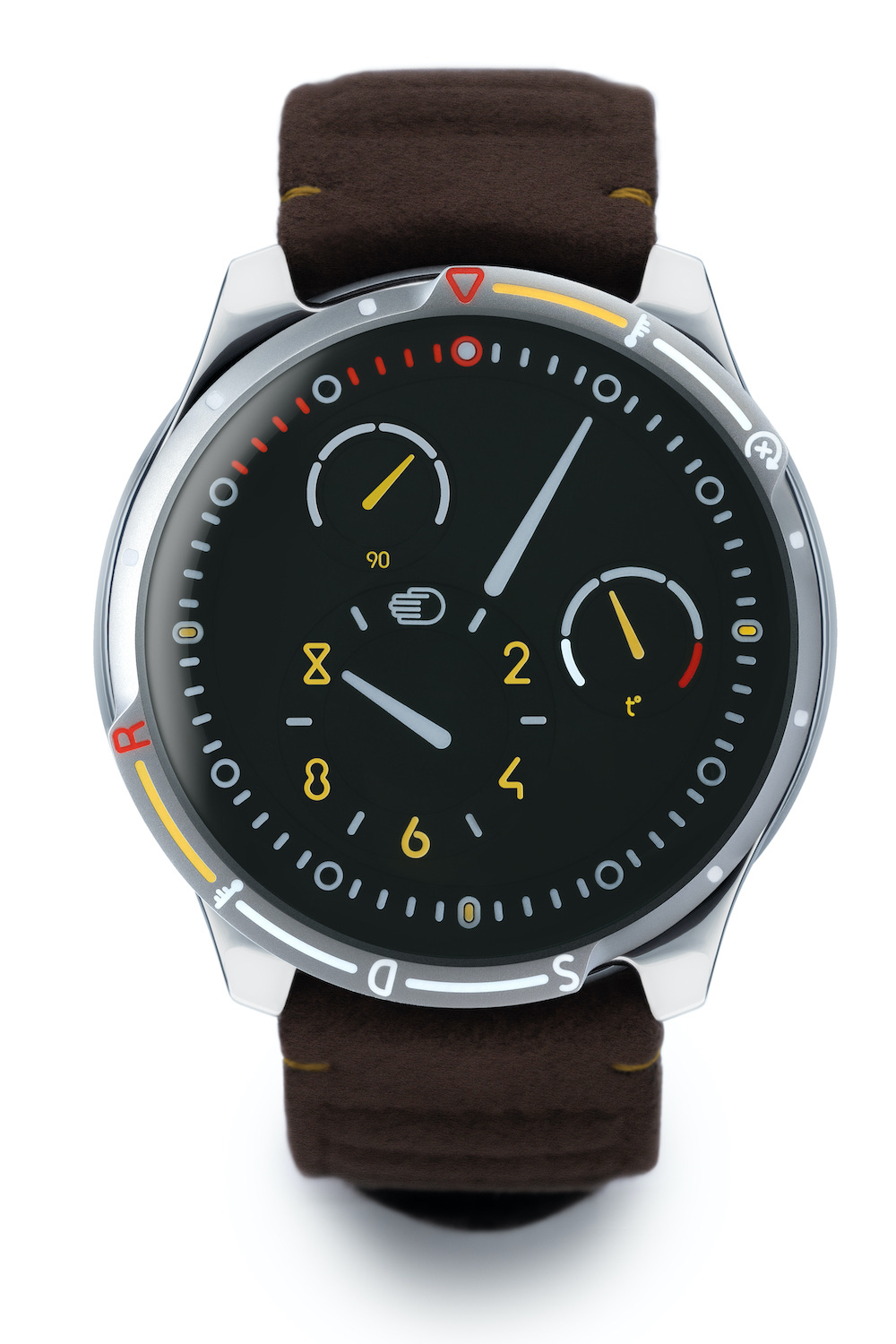
Subdial co-founder Christy Davis said that “People come to Subdial to find the interesting and collectable. A Ressence watch is intriguing from the moment you first set your eyes on it, and it feels like a perfect match. The watchmaking is unique, so it requires the CPO relationship to be able to repair and trade secondary pieces with trust. As the UK hub for preowned Ressence we hope to get a lot more of their amazing pieces into our Weekly Drops.”
Asked how significant the market is for pre-owned Ressence - a brand that still only makes a few hundred watches a year - Davis said: “Ressence watches tend to be found on the wrists of more committed collectors, so the secondary market for them is small but growing.” When it comes to servicing and repair, he explained that some, but not all would be undertaken in Clerkenwell (where, if you haven’t seen it, the company offers visitors a fantastic birds-eye view of its watchmaking benches when you arrive). “We have a hybrid approach to the technical aspects of CPO: some work is completed by Subdial watchmakers who have been given training and knowledge by the brand; and other repairs - like work on their oil-filled TYPE 3 watches - is done back at Ressence HQ,” he said.
The Two Sides Of Audemars Piguet
You may remember I recently went to Geneva with Audemars Piguet for the unveiling of the RD#5. I was pretty impressed, not only by the watch but by what I saw of the brand - as I have been every time I’ve visited. From Giulio Papi and Lucas Raggi to Sebastian Vivas and everyone who works with them, it’s a brand staffed with people who really love watches, and really know their shit. It’s very hard to fake that.
Not long after my trip, I was having lunch with the senior team of a contemporary indie brand and I found myself defending the credibility of AP’s R&D efforts. Having only recently stood in the room with the machinery and spoken to the people actively researching new material solutions for casemaking and so on, I felt obliged to back them up against the generally-held view that big brands are always hiding behind smoke and mirrors.
This week, a customised piece unique Code 11.59 made for contemporary artist George Condo was posted on Instagram, and with the usual caveats about personal taste, the eye of the beholder and so on, was pretty much unanimously panned. “The worst thing ever”, said one super-collector2 when I DM’d him about it. I expect it’s well made, but the question here is whether it was a good idea in the first place. Like a tasteful nude sent to a once-trusted lover, you have to assume it’ll get out eventually. I can’t honestly believe this is the same brand that makes the Royal Oak, and I’ve defended the Marvel editions in the past.
Now, these aren’t opposing positions - self-evidently, you can go out to bat for Audemars Piguet as a serious watchmaker and still have to accept that it makes some questionable decisions about its brand (viz. Spider-Man, Black Panther etc). But it made me wonder if there is another company that I hold (and from what I see on social media, I’m not alone) in simultaneously such high and low regard. Maybe this is the key, a feature not a bug, and the brand identity really is polarising choices combined with obsessively high standards3, and that’s the secret sauce that sets AP aside from Patek or Vacheron. But that feels awfully short-term for a legacy watchmaker. The willingness to do what others won’t - that can be very cool. I’d say it defines AP. But it needs to walk hand-in-glove with the wisdom to know when saying no is more profitable than saying yes.
Back to AP at its best: the brand has published a monstrous doorstop of a book, titled ‘The Watch: Stories and Savoir-Faire’. It’s something between a general introduction to watchmaking and an encyclopaedia, covering everything from atomic clocks to anglage. There’s acres of useful history, concise definitions and explainers of terms and practices, and while it is all presented through the lens of AP, it really doesn’t feel like a piece of PR. It’s a really impressive work and I suggest you seek it out.
Did This Rolex Oyster Really Cross The Channel?
I wrote elsewhere this week about the Rolex Oyster that’s coming up for sale at Sotheby’s in November: a watch that the auction house says in its press release was worn by Mercedes Gleitze on her ‘vindication swim’, a landmark moment not only in endurance swimming (as Gleitze became the first British woman to swim the English Channel), but in luxury brand marketing, as she also became one of the earliest celebrity brand ambassadors. Hans Wilsdorf recognised the media attention Gleitze was attracting, notably due to claims, later revealed to be a hoax, that another swimmer had made the crossing faster; hence the need for a ‘vindication’ swim in which Gleitze proved herself. Ironically she had to abandon the effort due to hostile conditions, but the point was made. Wilsdorf seized on the opportunity to equip Gleitze with one of his recently-patented water-proof4 watches, and then made the absolute most out of Gleitze’s celebrity.
The watch in question was sold in 2000 by Christie’s, consigned by a direct descendent of Gleitze herself, and fetched just £17,037. It looks a little different - the Christie’s image is pretty low res but it looks like a watch in white metal, not yellow gold. There is a clearer image of the watch on Jake’s Rolex World.
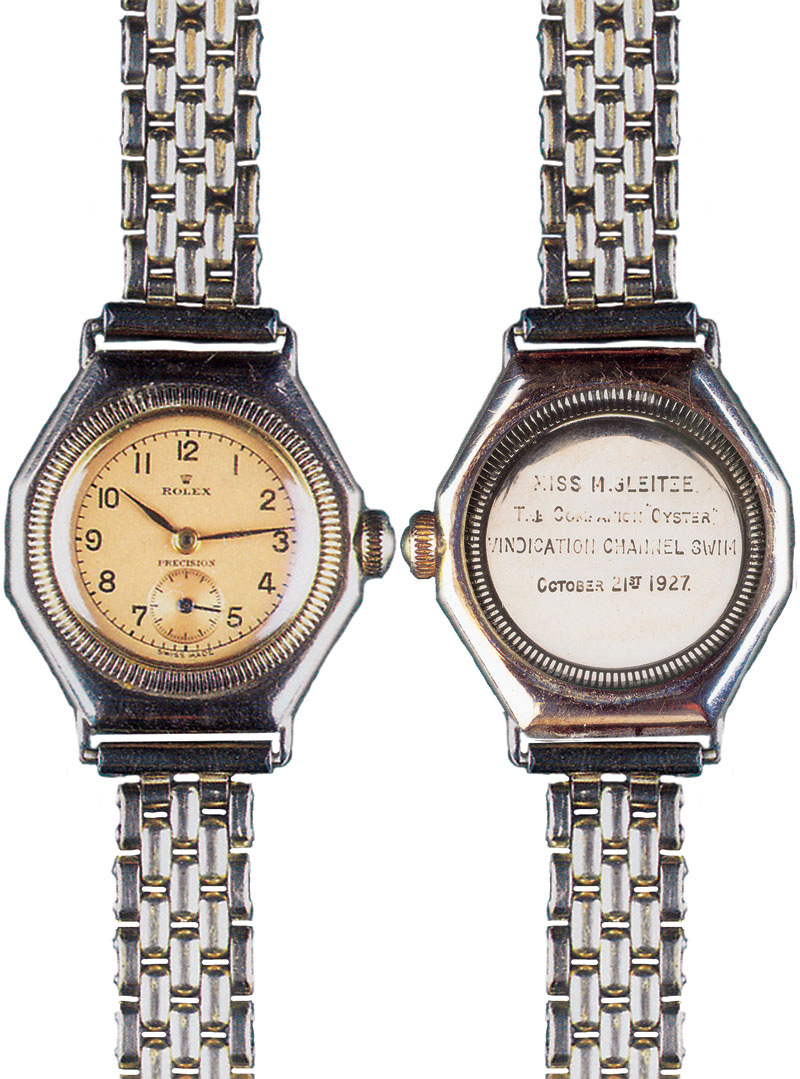
What emerged immediately after the Sotheby’s sale was announced were images that seemed to show a very different watch, when it was apparently displayed in the 1970s for the 50th anniversary of the Oyster. At a bare minimum it seems to have had a completely new dial and hands - and that prior to the sale in 2000. Charles Tearle put forward the theory that this was Rolex’s doing, which would make some sense - the brand has been historically famously uninterested in preserving originality.
But what’s less clear is whether this is the watch that Gleitze wore around her neck, or one that was given to her after the swim, as some experts whose word on Rolex I generally trust have suggested in private (Perezcope, as you would expect, is also suggesting it in public). The engraving, of course, would have been added afterwards either way.
I asked Sotheby’s for their comment and also reached out to Rolex.
