

Issue 201: Ask Me Anything, Vol. 20
Unfiltered and in-depth thoughts on: Pricing, Peak indie, Media overload, W&W hierarchies, Universal Geneve and more

Hello and welcome back to The Fourth Wheel, the weekly watch newsletter that is always amazed at how quickly Watches & Wonders recedes into the rear view mirror. Back to normal, just with a whole load of new things to feel excited/jealous/irrationally upset about - delete as appropriate. Today’s issue is another AMA, and I have once again been delighted to ramble on in response to your questions. Pricing was the one issue that came up repeatedly in different ways, but we also have space to talk about what Universal Geneve got right (and wrong) with its launch, the potential impact of ‘peak indie’, who has the highest status among W&W attendees and a few other things besides. A reasonable amount is in front of the paywall this week, because I’m feelin’ gen’rus. Enjoy it.
If you missed this week’s podcast, it was a good one, modesty be damned, and is also the only place I’ll be detailing my favourite releases from the fair. And yes, it’s video too.
The Fourth Wheel is a reader-supported publication with no advertising, sponsorship or commercial partnerships to influence its content. It is made possible by the generous support of its readers: if you think watch journalism could do with a voice that exists outside of the usual media dynamic, please consider taking out a paid subscription. You can start with a free trial!
Here’s a little taste of what you might have missed recently:


Ask Me Anything
I have a couple of questions… Amateur Hour Watches
At watches and wonders brands have four potential audiences - retailers, media, high value clients, public day punters. In general how would you assess the importance the brands put on each of these? Does it vary by brand? How has this balance changed?
In simple terms, the hierarchy goes: clients, retailers, media, public. And judging by the posts from the weekend (I’d left by then, naturally) there’s quite a big gap between media and public. Those first three are privileged groups, with varying degrees of VIP access, while the public has to queue up and pay for everything. Sorry to be so blunt but we do know how good we’ve got it in the press corps.
Obviously, some brands have different levels of retail activity; if you do most of your business direct, you aren’t reserving your 9am appointment on day one for Brian Duffy, CEO of Watches of Switzerland. But as a rule, money talks, and if you represent potential sales, you’ll find yourself behind the velvet rope.
This leads to some interesting little sub-dramas within that hierarchy. I can only really speak to the media side of things, but things do vary brand by brand in terms of their approach to different elements of the media. Only today I’ve seen Ben's Watches complaining on Instagram that some brands wouldn’t allow him onto the stand on account of being an influencer. By contrast, there are a few brands that gave some influencers - Adrian Barker, Justin Hast1 - advance access to watches so that they had video content ready to launch on day one. That’s the kind of prestige treatment that used to be reserved only for the top specialist media, or big-name titles like Vanity Fair or the New York Times. YouTubers (or Instagram/TikTok personalities) didn’t used to get invited on the press list, like I and my peers who came up writing for newspapers and magazines, but now a few do. The issue is partly brands being slow to adapt, wary of change and sceptical of platforms they don’t fully understand, and partly an erosion of the definitions on all sides.
For example, most retailers are now creating content for their own online channels. The Subdial guys were out there creating content like press, and even turning up in some press presentations - which was cool! Also, a lot of influencer content is nakedly pay-to-play, which changes your relationship with a brand. I met one Instagram content creator who was totally unabashed about the number of free watches they received for their coverage, and for the first time in my life, one indie brand said quite matter-of-factly that we should discuss media rates, i.e. how much they would pay me to feature their products. For the record, as if you guys and girls don’t already know it, that’s a non-starter with me.
Thoughts on the Universal Geneve launch?
Oh, so many thoughts.
The biggest question mark over the whole thing wasn’t how good the watches are but how clearly the brand positioning and identity was communicated. Breitling, sorry - House of Brands - had three years to prepare the landing site, so nobody should be surprised at the price bracket. The “Couturier de la Montre” tagline - which translates literally as “dressmaker of the watch” is relatively new messaging and this is the element that I think will take time to sink in, although they laboured the point pretty hard; the watch offering is structured under headings like “pret a porter”, “capsule” and “couture”. I get the basic idea: you’re stylish, European and sophisticated. It might be my ignorance but I don’t remember ever hearing the phrase in relation to UG when discussing its heyday; one problem I can foresee is that even among wealthy audiences, not everyone is familiar and comfortable with the language of high fashion. Anyone who’s been to a watch meet-up knows that the most jaw-dropping pieces can often be found on the wrists of guys who dress very conservatively. It’s good to have a confident sense of personality but this feels like an identity that could alienate people. On the other hand, it positions a new luxury watch brand as adjacent to companies like Louis Vuitton and Chanel, which is smarter than positioning yourself next to struggling giants like Blancpain and Girard-Perregaux. Given that UG’s core collections are descended from down-to-earth tool watches like the Compax and Polerouter, we’ll have to wait and see if the language feels forced, or if it’s toned down a bit now that the big reveal is out of the way.
If you strip away the language of fashion, the UG offering follows fundamentally the same template that Georges Kern outlined when he took over Breitling: that is to say, a number of product verticals each with a distinct offering at a certain price/quality category. It’s effective for mainstream volume brands but I wonder whether it’s a one-size fits all strategy.
The phrase “show, don’t tell” should be circulated in 50pt font throughout the House of Brands. The launch was a masterclass in hammering the message home. Whether the message is right or wrong is irrelevant (to this point) - there was just too much message.
As I have already mentioned on Instagram and in the TFW chat, the presentation of the watches was poor. Potentially good or even great products were dirty, dusty, and badly lit. Security concerns (understandably) meant attendees couldn’t handle the watches, which meant it wasn’t possible to see the movements that the UG team was so proud of, or demonstrate the Cabriolet’s revolving case. I had to persuade one of the senior team to show me the Polerouter calibre. There were so many ways to fix these issues and put on a launch that would have left us all seriously impressed, but if you were there to assess the watches it was very hard to come away with a firm answer. All the money and time had gone into the set-dressing for the keynote speech(es) and presenting the actual watches felt like an afterthought.
Georges Kern working the room before and after was appreciated. It’s nice to see CEOs who are approachable, and not afraid to answer questions on the spot from journalists, even going back and forth on fine details without becoming defensive.
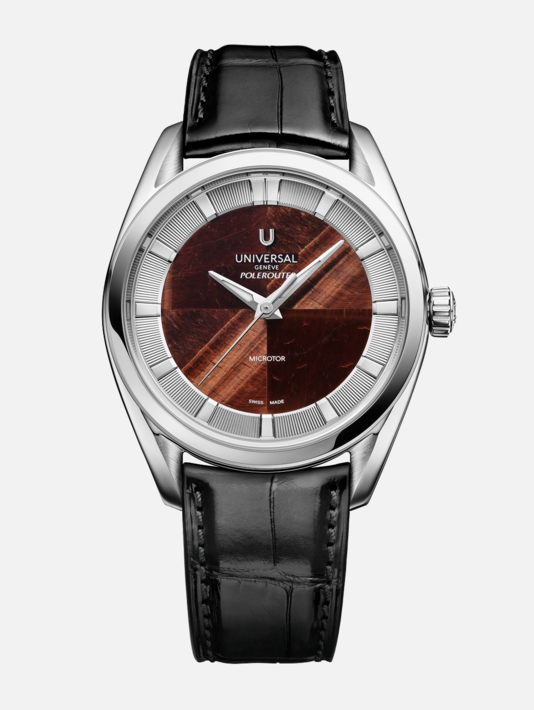
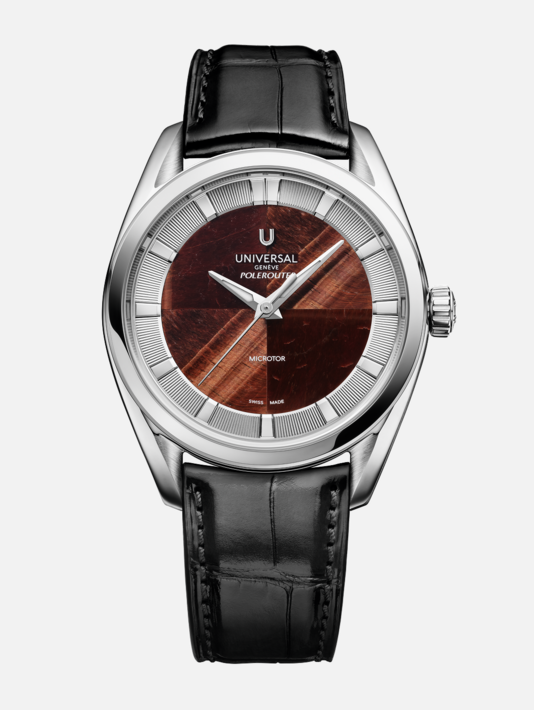
I personally liked the Polerouter in steel with a hard stone dial, above, the Compax in its simplest form, and the Disco Maxi and Dioramic, albeit not for myself. The Cabriolet was the most intriguing model in the main collection; I think the idea of including it was a good one, but the typography is going to date too quickly.
So many people are hung up on the comparison between vintage UG and modern. I can’t emphasise enough that even though the rebirth has had a team of midwifes from the collector community, the target market is not vintage UG collectors, and nobody is going to be weighing up an old Polerouter against a new one. It’s just not the same customer.
An unfortunate consequence of Gerald Genta’s prolific career and post-2016 beatification is that these days, his legacy feels somewhat commodified. I mean no disrespect to his original work, but we need to find a way to honour it without it becoming exhausting. I’m all for giving him the credit he deserves, and didn’t get at the time, but over the last few years we’ve tipped too far the other way and now there’s a slightly embarrassing level of adulation whenever one of his creations is mentioned. It would certainly help if there were any other designers to venerate, but compare the way Patek Philippe handled the anniversary of the Nautilus, or the fact that it is possible to talk about the VW Golf without opening a new shrine to Giorgetto Giugiaro every time you do so (who I just learned also designed a new shape of pasta. Now that’s cool.)
I think we get the discussion of what a watch “should” cost all wrong. Since a watch’s price is generally set before its designed, it is based on its expected positioning and this then drives the design. Therefore I think we should stop saying ‘this watch should cost X’ and start saying ‘for this price the watch is missing Y’. Thoughts?
I think what you describe is accurate for most mainstream brands; a lot of low-volume indies price their watches slightly differently. I think when reviewers - at least, when I review watches I do this - compare new products to their rivals, this is close to what you’re asking for. But the problem you have, whichever way you frame the statement, is that a lot of what governs a watch’s retail price is either intangible, i.e. it’s brand-related, or it’s structural, i.e. they have to consider whether they’re giving a margin to a retailer, distributor or not. It doesn’t make a lot of sense to say “for five grand, I expect to be buying this from a multi-brand department store, not direct from you,” but those are the economics behind the scenes.
If a brand is doing its job properly, it should at least be able to defend its pricing with recourse to hard facts: you may well say “for fifty grand, the Omega Constellation is missing a seconds hand”, but Omega can say “find me another METAS-certified solid gold dress watch on a bracelet,” and of course, you can’t. You can decide that Omega’s opinion of how much those attributes are worth is grossly inflated, but that’s your prerogative, and if they haven’t convinced you, that’s a problem with their marketing. That’s an extreme example chosen for a laugh, but what I’ve found is that brands are actually very careful not to make watches that are identically specced to a competitor - which means the ‘it’s missing Y’ construction can always be rebuffed with ‘ah, but it’s not the same’ - and all we can do is decide where that response sits on a spectrum of ‘total bullshit’ to ‘credible justification’. TL;DR - positioning is more fiddly than it first appears.
Chris, the highest-end indies / small producers have been a guaranteed profit game for the last couple years. Seeing Ferdinand Berthoud and the new Lange Lumen come out at €383K and €550K respectively, are the manufacturers catching up to that game and trying to capture secondary market profit for themselves, or is this just where the market is and those two watches will actually trade above retail in secondary market too? - Jith
The question of ‘leaving money on the table’ is one that has come up time and time again since the pandemic turned independent watchmaking from a niche folly to a fast-track for flippers. (I exaggerate, but not by much). It’s a delicate one.
Anecdotally I’ve heard collector gripes concerning the likes of Roger Smith, whose prices are said to have risen dramatically in recent years2 . And I expect we have all heard stories about prices going up while you’re on the waiting list - that seems to have been a Lange thing, among others.
I can see the various pressures on makers; it’s not just about capturing profit, but keeping up with the competition. If others are doing it, you’ll be forced to follow suit, lest your products slip into a different price category altogether. Of course, some brands opt to keep prices under control and pitch their customers on value for money, but if you say you make some of the best watches in the world, you are also going to want to be sure that you’re priced accordingly.
It’s also an increasingly expensive business, and the lower your volumes and more inflexible your overheads, the more aggressively you’ll be squeezed by recent economic shifts. But let’s not pretend for one minute that there isn’t a healthy margin built in - top-line Lange models are now regularly more than half a million; last year’s Saxonia Minute Repeater was €750,000! I suspect that the top end of the market is displaying the same behaviour as the market overall, just in a more exaggerated way: making more and more of its profit from fewer and fewer customers3.
As for whether these kind of watches will still trade above retail, let’s look at some data, shall we?
Data on Ferdinand Berthoud is scarce, as the volumes are so low, but the models that have come to auction at major houses have consistently surpassed their estimates by significant margins since 2022. But that’s only a handful, and auction are notoriously unreliable indicators. Marteau sold an FB2 RE.1 in its first sale last year for $301,053 according to Everywatch, which I bring up purely because Marteau’s model is relevant when we talk about ‘leaving money on the table’ in that it returns a percentage of the hammer price to the original maker. That’s a watch that retailed for around $230,000 in 2020.
Grand Lange 1 “Lumen” models seem to have hovered around the $100,000-125,000 mark at auction for the last few years (either reference 117.035 or 139.035) and Datograph “Lumen” models (405.034) have hammered for between $160,000 and $250,000 in the last four years. The Lange 1 Lumens retailed for around $75,000-$80,0004 at launch, while the Datograph Up/Down Lumen in platinum cost approximately $110,000 new in 20185 so in six years, that has seen a significant increase. Again, those figures are courtesy of Everywatch’s auction tracker. Looking at dealer listings, the spread on Datograph Lumens in the last six months has ranged from $215,000 to $294,000.
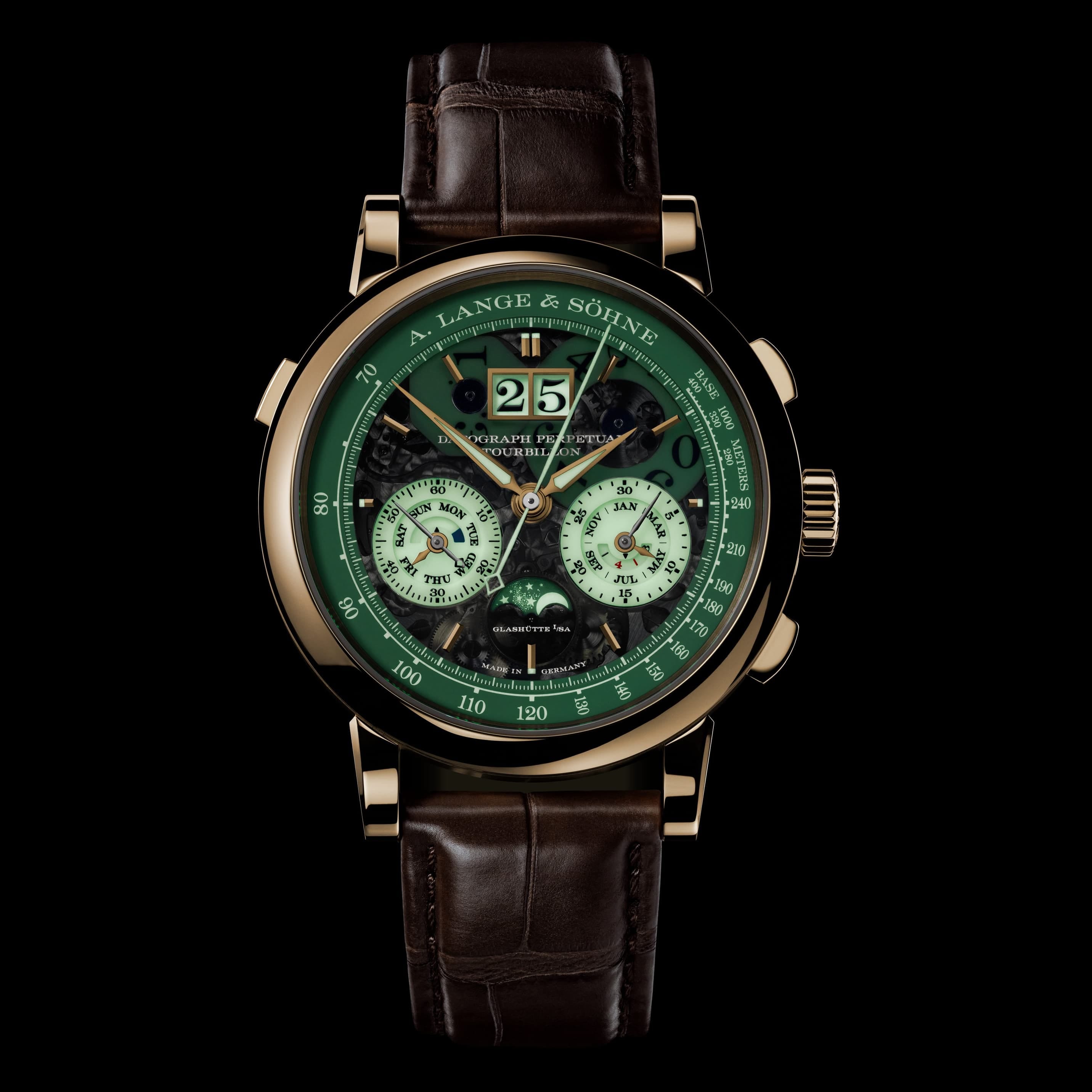
A Datograph Perpetual Tourbillon Honeygold “Lumen” - aka just about the most desirable combination in the Lange universe - retailed for approximately €620,000 at launch in 2024. That’s roughly a sixfold increase on the 2018 Datograph Up/Down Lumen’s launch price, just six years later, but it’s a different beast entirely, adding a perpetual calendar and tourbillon; it was also four times as limited (50pcs vs 200pcs). One has come to auction so far, in 2024, and it sold for $635,000, or basically exactly retail price, when presumably demand would have been at its highest and waiting lists at their longest.
That’s just one single sale, though, and obviously each individual reference is so limited in number it’s hard to find apples-to-apples comparisons. There is one listing for last year’s minute repeater on Chrono24 but it’s POA and uses a stock image, so I doubt it’s real. We need more time to see how these mega-budget models are going to depreciate or appreciate.
But maybe there are some other metrics that could help. One question I wondered about was: how many A. Lange & Sohne watches have ever changed hands for more than half a million dollars (that we know about)?
