

Issue 208: Girard-Perregaux Laureato 39mm Review
It's better than the old 38mm, but it had damn well better be for a 50 per cent price rise

Hello and welcome back to The Fourth Wheel, the weekly watch newsletter. Conversations about price and value are inescapable this year, it seems - like the jaded old TV detective, I was nearly out… but the job just pulled me right back in. Or something. It would be nice to engage with a watch on a different level once, to write you a passionate essay about its cultural significance, the waves of emotion that swept over me as I held it in my hands, or to spend rapturous paragraphs detailing the incredible craft that has gone into it.
But this is not that day. Today, we take a look at at a watch in the inner circle of a genre that has sprawled beyond all expectations, a family of watches that have gone from being a niche concern for aesthetes to a commodified totem of modern luxury. What can the Girard-Perregaux Laureato Fifty tell us about the integrated bracelet watch in 2026? It’s very easy on the eye, but does it flatter to deceive? Let’s find out.
The Fourth Wheel is a reader-supported publication with no advertising, sponsorship or commercial partnerships to influence its content. It is made possible by the generous support of its readers: if you think watch journalism could do with a voice that exists outside of the usual media dynamic, please consider taking out a paid subscription. You can start with a free trial!
Here’s a little taste of what you might have missed recently:


Review: Girard-Perregaux Laureato Fifty 39mm
“Which one would you like?” Never a bad question when the answer will see you walk away with a brand new watch for a few days. I had the option to review either of the two new 39mm Girard-Perregaux Laureato models, and it may be a disappointment to some of you that I didn’t choose the blue-dialled, no-date version. Fear not, though, I have handled both and will explain myself as we go.
What is it?
One of four new Girard-Perregaux Laureato models that just launched: alongside one other 39mm model with a blue dial, there is also a 36mm reference with the same rose-gold tone dial and a 36mm model with a silver tone dial and diamond-set bezel. I first saw it under embargo in Geneva in April, have just spent a few days with it, and it is available to buy now.
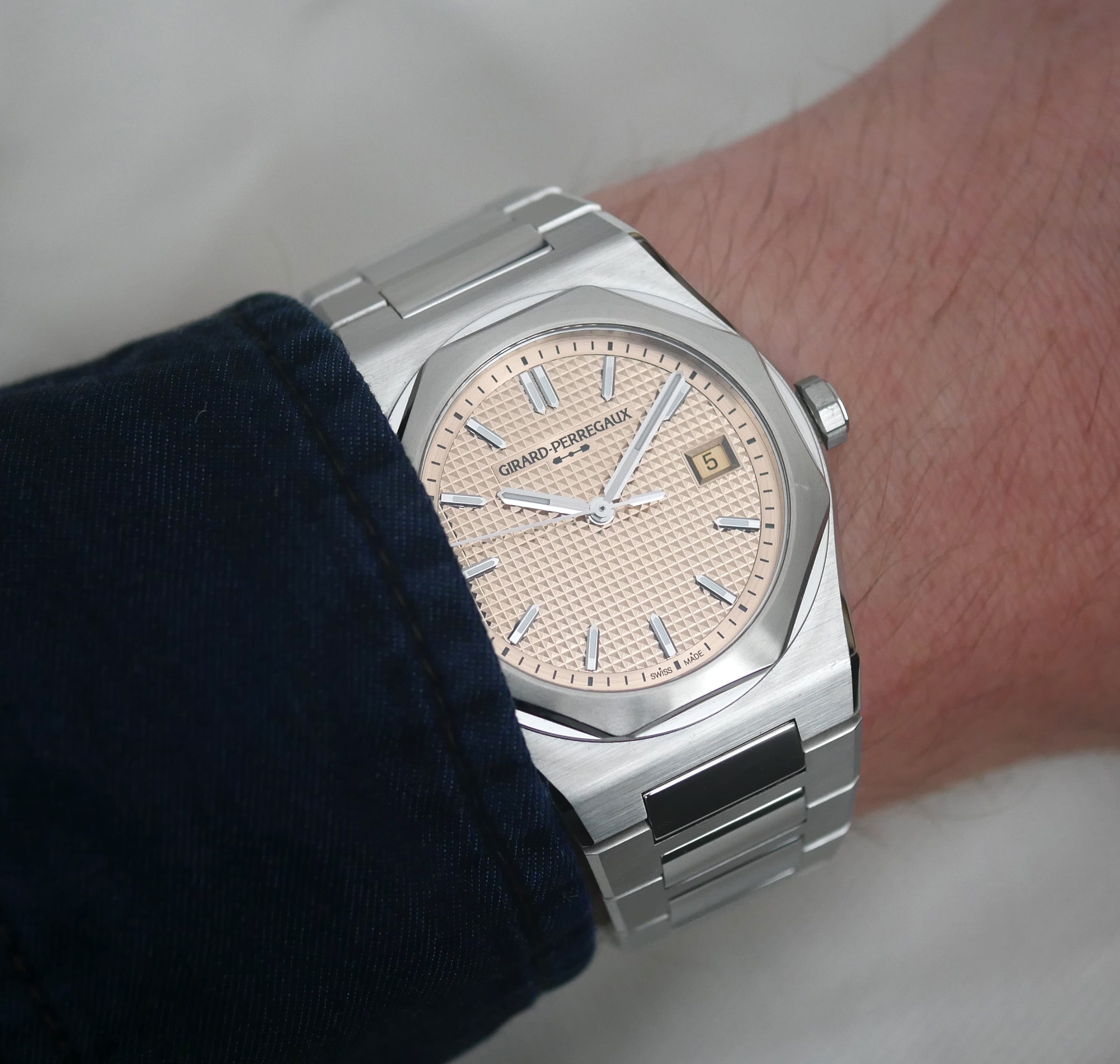
It follows in the footsteps of last year’s commemorative 50th anniversary edition, which was only released in two-tone steel and gold, and effectively replaces the Laureato 38mm which is being discontinued.
What’s new: Design and Movement
It’s bigger! By a millimetre. Shall I go on? The size difference is not the most important thing, but I think 39mm is more of a sweet spot size for more people. I’m surprised it has taken Girard-Perregaux this long to get there with the modern Laureato; brought back a decade ago at 41mm, the 38mm version followed the next year and I think I’m right in saying the 42mm version launched in 2022. This kind of messing around isn’t totally unheard of - in fact it’s pretty common - but taking the long view it kind of tells me you’re either just not sure where your design belongs or are being too reactive, or both.
Also more important than just one measurement is the overall package of design tweaks. I don’t have a Laureato 38mm here with me, but I’ve worn it before, and poring over pictures I think the new case is ever so slightly less curved in its flanks (I could also just be convincing myself to see a difference that’s not there because I want it to be; certainly if it is different, it’s subtle as hell). What’s not up for debate is that the bevelling on the case and bracelet edge is thicker, and I like that.
The crown is different; now we have an octagonal crown with flat sides, rather than the grooved circular crown. The other aesthetic differences are on the dial: gone is the GP logo at 12 o’clock, and with it the “Laureato Automatic” text at six. The arrowhead bridge logo and brand name are now printed in black on gold (rather than white, as they were on the slightly darker copper-orange dialled 38mm model). The date window appears to have a thicker bevelled edge, and the hands now have a slight facet to them rather than being flat, stamped, simple things.
The Clous de Paris dial - wherein lies a disproportionate percentage of the watch’s appeal and certainly it’s personality - is still, to the best of my knowledge, stamped rather than machined with a pantograph like a Royal Oak1. It looks very crisp though, and aside from understanding where a more laborious process has taken place, I have a hard time seeing how it could be improved - but then, that’s the whole ball game, isn’t it? The means matter at least as much as the end.
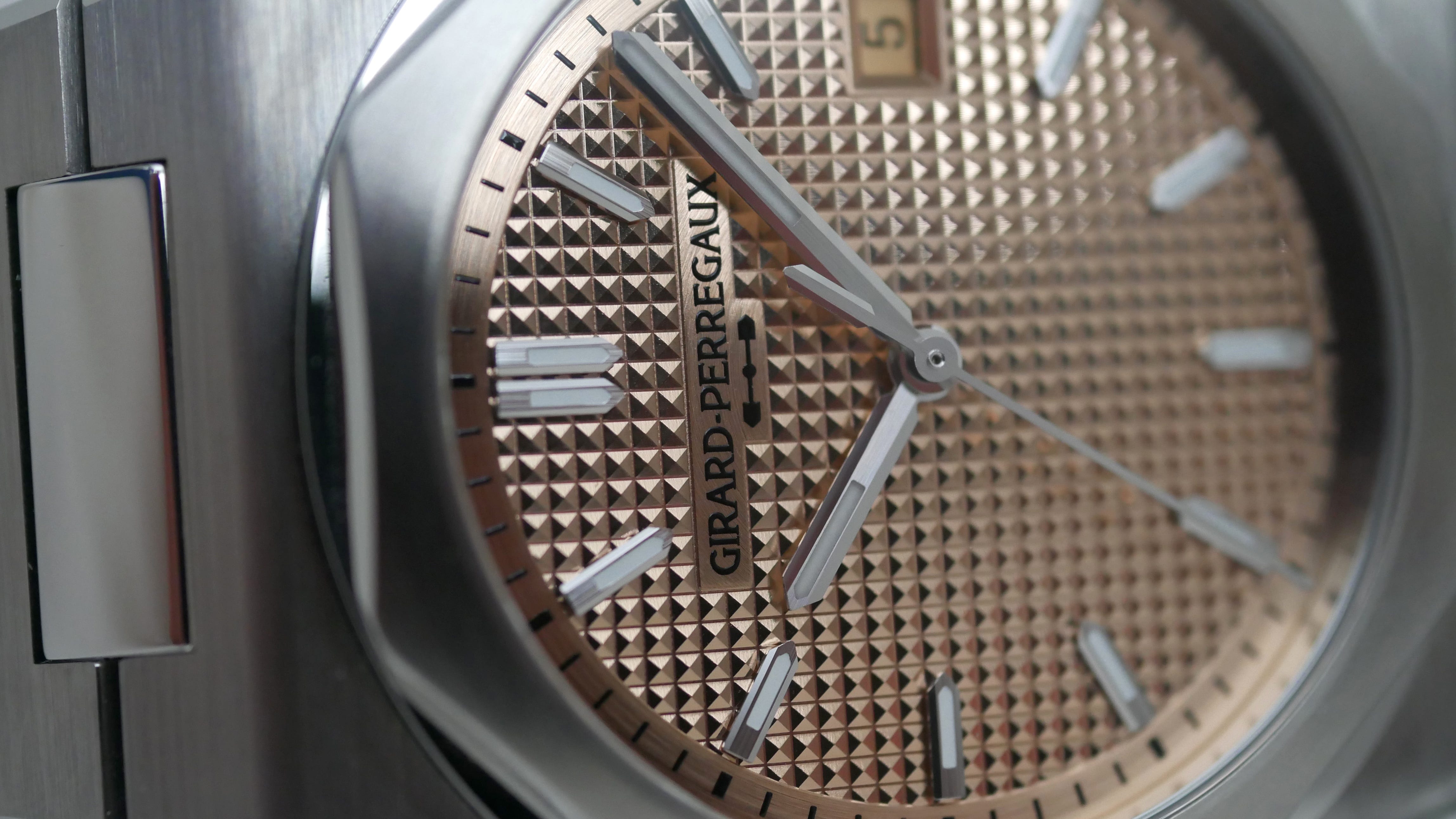
What else… the lume is pretty decent for the size of the appliqués and hands; the water resistance at 150m is totally fine, the bracelet now has a micro-adjustment facility - truly, 2026 is the year of the micro-adjust - and then we come to the movement. This is without a doubt the biggest change and normally the one you would lead with: the Girard-Perregaux Calibre 03300 in the outgoing Laureato was introduced in 1998 and based on the 3000 family of movements that were developed in 1993-4, so it has had a good run and no mistake.
The new Laureato runs on Calibre 4800, which was introduced last year, and while it is undoubtedly news that a company like GP has replaced such a well-known and respected movement (it, or movements derived from the same base, has been used by Vacheron Constantin, Daniel Roth, MB&F and others), the important question is what exactly has changed.
Others have written in-depth articles just on the 4800 calibre alone so I will not rehash the entire thing, but it runs at 4Hz, like the old movement, and achieves a roughly 25% improvement on its power reserve, up from 46 hours to 55. That isn’t much to shout about; on the other hand, I have been saying for a while now that power reserves, particularly on automatic watches, have become a number that the industry has realised it can quite easily optimise for, i.e. an easy way to sound ‘better’ in a Top Trumps kind of way. Is 55 hours impressive? No. Is it adequate? Probably. But nobody apart from Rolls-Royce ever sold anything on the basis of words like ‘adequate’, so this does feel like an odd miss from GP. Especially as it isn’t compensated for by any particular achievement in another area - at 4.28mm thick and 25.6mm wide it’s no monster, but it’s not ultra-thin either, and it makes no specific claims about accuracy or magnetic resistance, to name just two criteria. The baseplate says ‘silicium escapement’, which is true, but the hairspring isn’t silicon, only the escape wheel and pallet fork.
Jaeger-LeCoultre’s new version of Calibre 899, by contrast, measures 26mm x 3.3mm, runs at 4Hz with a single barrel and delivers 70 hours of power, is COSC certified (and meets the brand’s own HPG standard) and looks at least eight tenths as nice to my eye.
