

Issue 210: Ask Me Anything
Who'll buy Ronda's new silicon movement? How can brands beat psychological price barriers? Should you call out CEOs exaggerated claims? And what exactly is the whole deal with F.P. Journe?

Hello and welcome back to The Fourth Wheel, the weekly watch newsletter with answers that fit your questions as neatly as hand-cut wolf’s teeth. Side note: I am always listening out for great names for watch-themed drinking establishments, and I’ve just realised that The Wolf’s Tooth would be a fantastic late-night rock bar. I am obviously not the first to think of The Spring Bar (your mainstream watering hole), and I think there’s also space for The Three Bridges (old man pub), Three-Quarter Plate (family restaurant), The Fusee & Chain (Gastropub) and I am absolutely certain you could make a success of a fine-dining restaurant simply called Tourbillon1. Send in your suggestions - we’ll make a whole city’s worth.
In the meantime, please enjoy this, the 21st AMA. We’ve got questions on F.P. Journe market trends, a bold new mechanical movement that could be game-changing but… might not be, the three ways a brand can break out of its price bracket, executive bullshitting and the fast-changing world of watch journalism. Enjoy!
The Fourth Wheel is a reader-supported publication with no advertising, sponsorship or commercial partnerships to influence its content. It is made possible by the generous support of its readers: if you think watch journalism could do with a voice that exists outside of the usual media dynamic, please consider taking out a paid subscription. You can start with a free trial!
Here’s a little taste of what you might have missed recently:


Ask Me Anything
A wonderful crop of questions this week - thank you very much to everyone who sent one in.
One question stood out above the others, and after about five minutes’ consideration, I decided it deserved a whole newsletter in response. NorcalWatch on Instagram asked “What watchmaking “problems” are still out there to solve? and you will be able to read my answer to that, in full, next week. We’ll talk about accuracy, complications, materials, levels of resistance, wearability and probably a whole lot of far-fetched hypotheticals. It’ll be worth the wait I promise!
What are your thoughts on the Ming X J.N. Shapiro collab? - BigWatchGuy
I liked it a lot. Saw it in person at London Watch Week and it did not disappoint. It’s pretty loud, certainly not something everyone would be comfortable with and a lot flashier than my daily diet of green and orange dive watches. But I thought it was really well executed.


Explain the Journe hype (Loaded question as I will attempt this too..!) - KingFlum
This feels like a trap; you’re bound to give this more space than I have time to, but let’s try a five-minute version. I also feel like I’m being asked to explain Journe to a Journe expert so please, be kind.
Herd mentality/critical mass. I’m not sure exactly when - probably mid-Pandemic when a Chronometre Bleu became sheer unobtanium - but at some point FPJ passed a tipping point and became a status symbol, detaching considerations of rarity and intrinsic quality from desirability. Once that happened, it wasn’t surprising that prices kept rising, and that momentum becomes self-perpetuating; even now, people must be assuming the market is going to continue to rise. Their confidence fuels it all anew, and on we go.
Meets the basic criteria in terms of market dynamics. There is just enough supply in the market to keep it active and draw in new buyers, but it’s rare enough not to be at risk of dilution. On that point; brand management of individual references has maintained scarcity within the collection.
Then there’s brand positioning and design - it’s conservative/traditional enough to have wide appeal, while doing just enough mad stuff (FFC; Gino’s Dream) to maintain indie brand credibility. The aesthetic was set early on and hasn’t been muddled since. It’s well-finished but not extraordinarily so (see point about volumes) and FPJ’s choice of particular challenges to address (Resonance; Centigraphe; Vertical Tourbillon etc etc) are by luck or judgement not things others have tried.
Trend-setters. How many people does it really take to move, or make, a market? We’ve all heard about WatchBox, now 1916 Company, allegedly hoarding stock; add a few Ben Clymer-level personalities who love the brand and you wield a lot of influence. This isn’t judgement2, just statement: the opinions and actions of a few can have a huge impact.
Patek & Rolex fatigue. For years the auction market had two bankable commodities, and eventually people got bored of selling the same Daytona or 2499 backwards and forwards to each other. There was a gap for something new.
A big part of examining this is to ask ‘could it have happened to another brand?’ I think in theory, yes, but Journe occupies a real sweet spot. Others have the aesthetic, the quality, the longevity (Voutilainen, for instance) but not the volumes (although worth noting that Voutilainens are flying). Some have the volumes but are too polarising (De Bethune) or not sufficiently exciting (Laurent Ferrier). The answer to ‘why isn’t it happening to other brands’ is, I think, that there isn’t space in the market for another Journe yet. It has proven it is possible but in doing so it has occupied that slot; another indie brand looking for the same success must compete not only with PP and Rolex but with FPJ, a brand with which it will inevitably have much in common but probably seem inferior to in at least one or two ways.
I’ll wrap up by asking myself what could bring the Journe train to a halt. Some people out there are talking about ‘proximity to the artist’, i.e. a rush to buy Journe while FPJ himself is still running the show. Who knows how long that will be for? Journe declined to be interviewed when I wrote about succession planning eighteen months ago. Wishing him a long and happy life, we’ve probably got ~10 years with him in charge - he’s currently 69 - but if this rush lasts a decade it will be quite the phenomenon. If his Chanel investment is in any way similar to MB&Fs, the long-term future of the company is probably pretty safe3, but any drop-off in supply would I expect lead to a short term spike followed by a decline in interest. A drop-off in quality or relevance is plausible - it might feel very unlikely right now, but the unforeseen always is. More likely, if the market is behaving as I outlined in point one, anyone who has been buying out of a sense of status-driven acquisition (consciously or otherwise) will inevitably move on, and demand will cool. A ‘true’ collector (gatekeeping alert!) will stick by the brand no matter what; the multi-million-dollar question, I suppose, is whether there are enough of them to keep outbidding each other.
What did I miss?
What’s the best way you’ve seen a brand overcome a price psychological barrier? - Kler Watches
This turned out to be a really interesting - and difficult - one. The idea of a ‘price psychological barrier’ is more specific than just asking ‘who has been able to raise prices with the least pushback’. The answer to that would just be Rolex, because brand equity/resale value/demand continue to far outstrip supply, and it has taken a frog-boiling, gradual but relentless approach to prices rather than the kind of clumsy jumps seen elsewhere.
No, the idea of a psychological barrier has two parts, if you like: it’s “I won’t pay more than X for Y.” That could be “I won’t pay more than £3,000 for anything with a Sellita movement”, “I won’t pay more than £10,000 for a dive watch, no matter what it’s made from,” or “I won’t pay more than £50,000 for a watch that isn’t even substantially hand-finished.” One of the biggest problems we’ve seen lately is that real prices have been changing much quicker than we can re-frame our personal psychological benchmarks - and one of the most stubborn psychological barriers is the one we construct around brands.
I really struggled with good examples for this. In general, I think it is very hard for a brand to operate outside its comfort zone for any length of time - or to move market segments altogether. That brings another caveat (I will answer the question, I promise), which is that limited editions and very specific excursions outside a brand’s normal parameters can be forgiven, with varying degrees of ease depending on how convincing the product and the story.
Furlan Marri teaming up with Dominique Renaud (collaborations - another caveat!) to make a perpetual calendar for Only Watch (RIP), is one example of it working well. Bremont making tourbillons is something I consider less successful - but it must be pointed out that the brand always says its high-end pieces sell out. There are other measures of success, but I feel that should be included for balance.
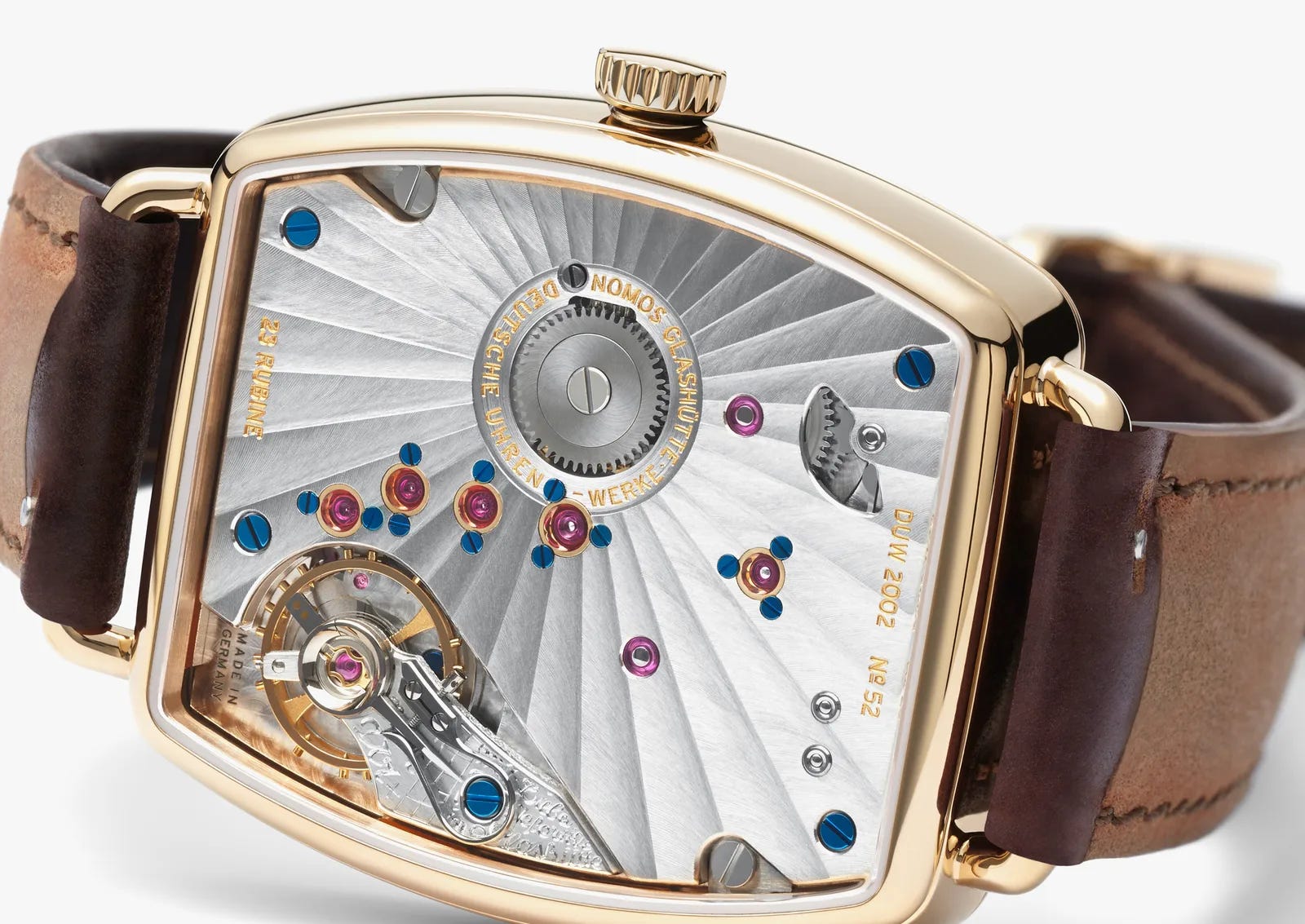
My mind goes back to Nomos making its gold-cased Lux and Lambda references, more than a decade ago now. They represented a big jump in price from Nomos’s typical watch, and aren’t officially limited editions - they remain in the catalogue, although production is very low. They worked because a) Nomos had worked hard to generate a lot of goodwill among press and customers, b) they looked good, were clearly better made than a two grand Tangente, and c) Nomos communicated very clearly what its intentions were, so nobody got the wrong idea about the brand changing its approach.
Another more recent example would be the Christopher Ward Bel Canto. The first edition launched in the UK for £2,995 on a leather strap and £3,550 on a titanium bracelet. That wasn’t actually the brand’s most expensive watch at the time - it had released the C60 Concept limited edition the year before for £3,495 - but that was a 210-piece limited run, and the Bel Canto went on to sell, and sell, and sell. CW managed to get past ‘three grand for a Christopher Ward?!’ by making the conversation all about ‘only three grand for a chiming watch’. I’m not saying it was a triumph of marketing over substance; the substance was there and it marketed itself.
I have one more example from a slightly different playbook. I’m sure plenty of you will remember Richard Mille’s first sapphire-cased watch, the RM 056 from 2012. It cost $1.65m and only five were made. When Richard Mille launched as a brand, eleven years earlier, the RM 001 cost something like $150,000 - which was in itself audacious, and probably constitutes a good example in its own right - but within just over a decade it had produced a watch costing ten times as much. I’m sure there will be examples, probably heavily gem-set ones, but I don’t remember anything really costing more than a million dollars at retail back then. The most expensive watch I’d handled prior to that was, I think, a platinum Vacheron Constantin for around £500,000. RM had made watches in the same ballpark, even nudging $800,000-$900,000 for split-seconds chronograph tourbillons. But breaking that psychological seven-figure barrier, not by a little bit but blowing past it to $1.65m… that stayed with me. And it worked; of course, people said it was insane, but they had come to expect the insane from RM. Which is of course the moral of the story: if a high price is expected, perhaps even demanded, then it becomes part of the product’s appeal rather than a barrier. The fact that is such a high barrier for 99.99 per cent of us is entirely the point.
So there you have it: three strategies for successfully operating beyond your normal price bracket. You can be careful, conscientious and considered, relying on communication and the knowledge that it isn’t going to go to your head.
You can be naive, brave and plucky - and work really, really hard. You can only do this so many times, though.
Or you can be outrageous, but for this to work you have to be outrageous from day one and sustain it. While also making sure the underlying product is still well made.
Good luck!
