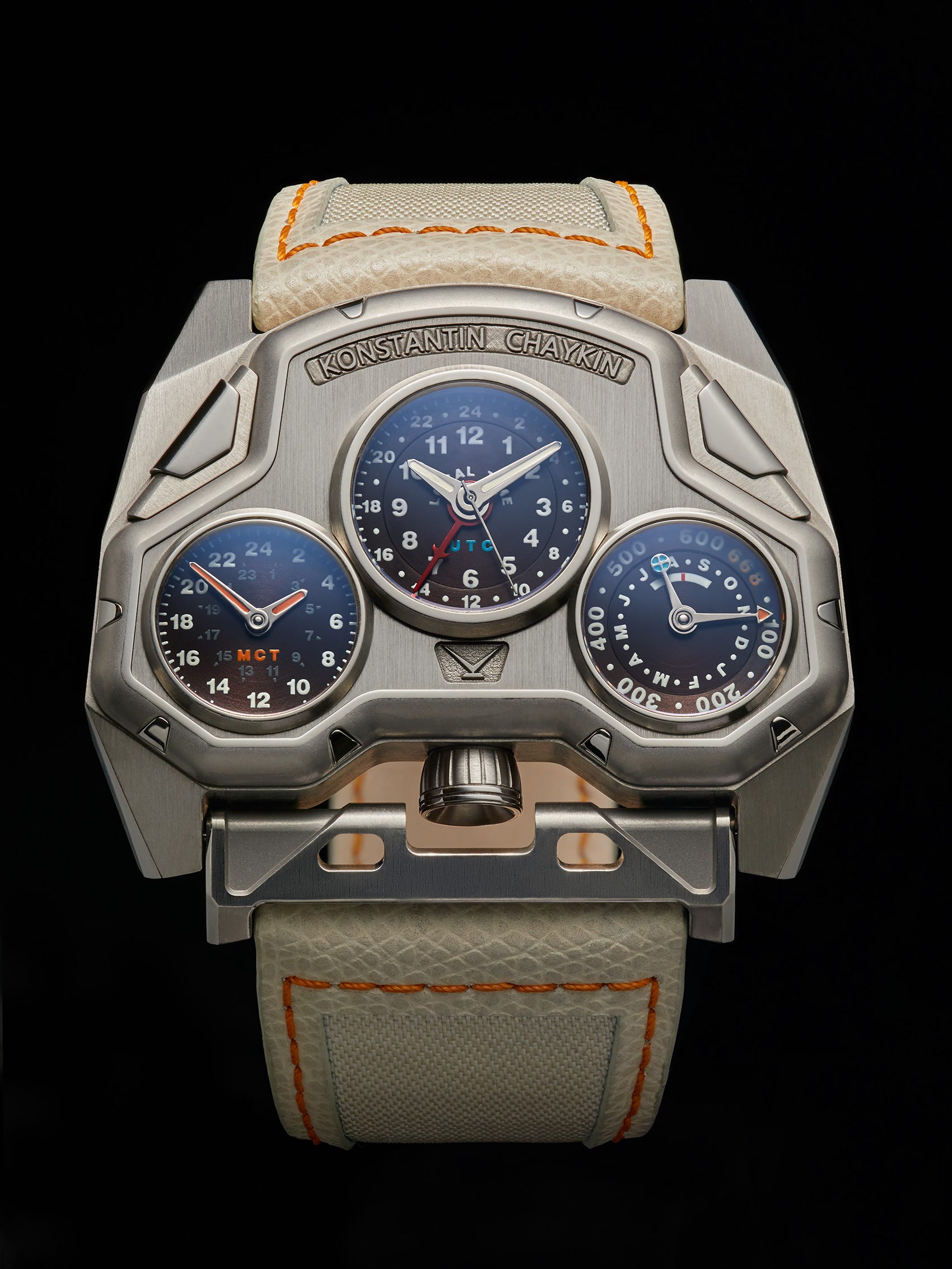
Hello and welcome back to The Fourth Wheel, the weekly watch newsletter that apologises for last week’s absence. It has been a funny old summer. What I hope is that things are back on a more even keel, and I can focus on writing some interesting stories between now and the end of the year. This week, an interview (of sorts - more on that later) with Konstantin Chaykin, a watchmaker whose work has interested me for years. We spoke about his Cinema watch in our ‘craziest complications’ podcast episode and I’ve covered his Mars Conqueror watch here as well.

It’s a bit trite to say that as an indie watchmaker he pursues ideas others ignore and finds a unique interpretation of classic horological themes; that’s what an indie watchmaker is supposed to do. Nevertheless, both aesthetically and technically, Chaykin’s work is without direct comparison. Latterly, he has become well known - perhaps better known than ever - for his Joker and subsequent ‘Wristmons’ designs, watches with eyes for indicators which turned out to lend themselves very nicely to pop-culture influences. These opened up opportunities for collaboration with more affordable indie brands like Louis Erard and Behrens. In 2024, Chaykin surprised the world with the ThinKing, an ultra-thin design that snatched the outright title from Richard Mille’s Ferrari UP-01. Chaykin founded his company in 2003 and is 50 years old; younger than many of his peers who have been in business for a similar time, because he didn’t come up through the Swiss ranks. He’s completely self-taught and in 2010 was admitted to the ranks of the AHCI, the first and to date only Russian watchmaker to receive the honour. His latest watches include the ThinKing Mystery and Matroskin.


A note on paid subscriptions
Free subscribers can now read one free newsletter per month, thanks to a new feature Substack has introduced. Unlike the way I used to operate - whereby the first newsletter of every month was free - this lets you choose which Issue you’d most like to use your free credit on. After that, you’ll be prompted to join the ranks of the faithful, or wait a whole month - God, that’s ages - before it re-sets. Let me know what you think!
Here’s a little taste of what you might have missed recently:


Q&A with Konstantin Chaykin
I’d like to start by saying this isn’t how I like to do things. In an ideal world, an interview should happen in person. Next best, and most common, is over the phone or a video call. This is usually good enough to establish a rapport, but does have its own difficulties. Quite often, especially in interviews with celebrities, who generally would rather be doing anything else, you’ll find they’re trying to do the interview during another activity. Often they’re in the car - I’ve interviewed the captain of the All Blacks, Sir Ian McKellan and a former USAF fighter pilot, among many others, while they were driving or being driven (not at the same time, sadly) and it is rarely a recipe for getting someone’s undivided attention.
Quite a long way further down the journalistic list of preference is the interview by email. This is often insisted upon by big brands and universally detested by writers, who are well aware that the answers are being written by the PR team and passed in front of the CEO for his or her sign-off and have been carefully edited to avoid including anything off-message.
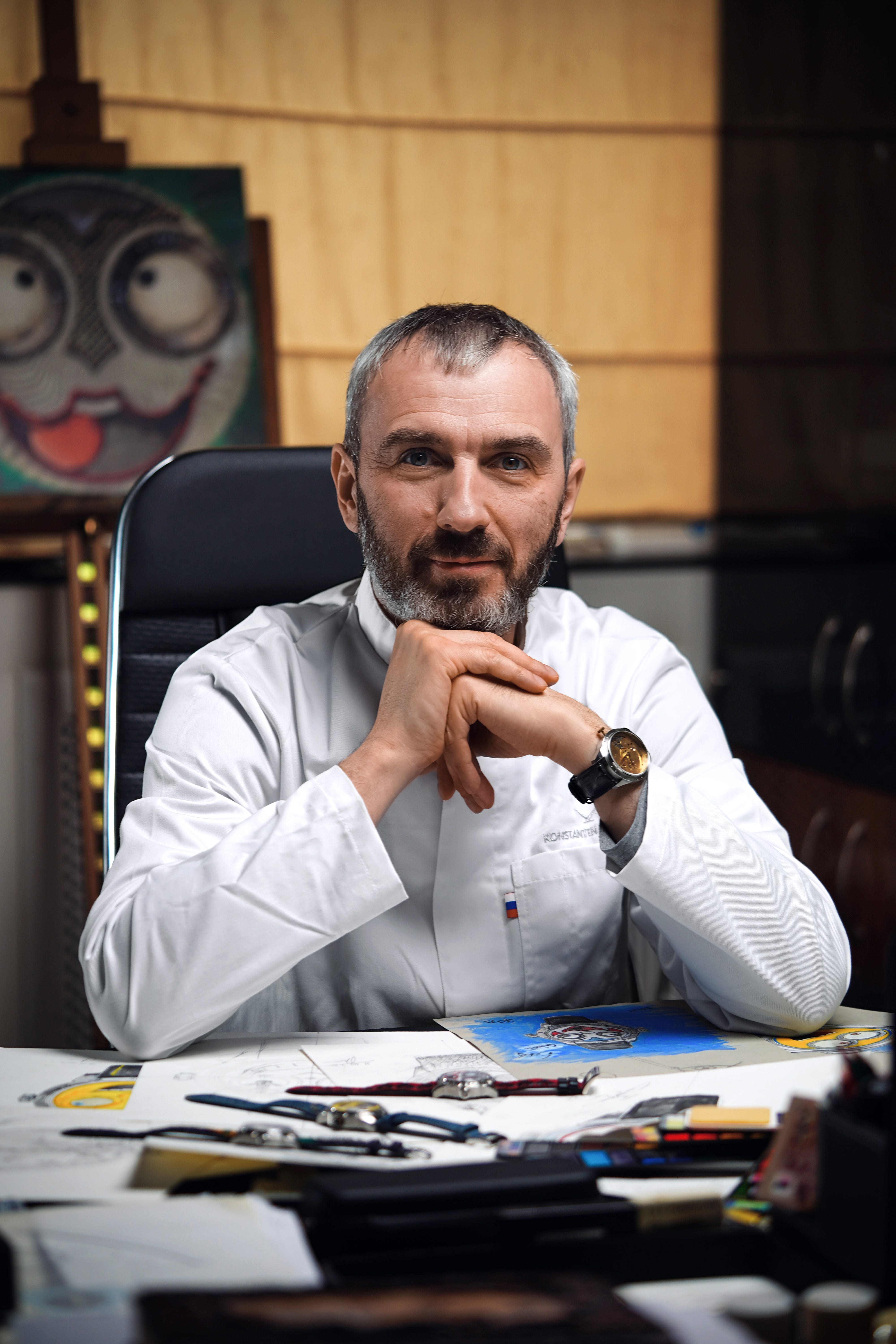
I don’t normally agree to this kind of interview. If a magazine needs a quote or two and it’s the only way they’re going to get them, sometimes you have to go along with it, but I wouldn’t do an entire profile this way.
For this conversation, however, Konstantin Chaykin answered a list of written questions: we had a language barrier to surmount, and while we could have tried to have a call through an interpreter, neither of us could find the time - and that’s hardly a perfect situation either. I can’t be certain that he wrote every word himself, but I am choosing to trust him and his team, not being a giant faceless corporation nervous of upsetting things. There was only one topic that they said they would not discuss, which you might be able to have a guess at. I’ve edited his answers for length (barely, though), and my questions to make me sound really smart1.
TFW: You said recently (to Fratello) that your magnum opus has not yet been created. Do you have any idea of what it could be?
KC: I truly hope that my greatest work is yet to be created—and thank God for that. I can see and feel that it is possible to create pieces that cannot even be fully conceptualised or grasped just yet. For now, they exist only partially in my head, but bringing them to life will require overcoming a long series of obstacles.
A magnum opus, strictly speaking, should be a singular creation. It doesn’t necessarily have to be the most complex piece, nor does it need to encapsulate the entire volume of one’s creative output. But by definition, it signifies the ultimate work of a lifetime. And internally, I would hate to claim that I have already created something of that scale.
A true magnum opus, in my view, must absorb all accumulated skills and experience, while simultaneously expressing the depth of the author’s vision and my personal philosophy. It must stand out so noticeably among other creations that it can be unconditionally recognised as the main one. Today, I am rather gathering individual fragments of this future magnum opus—much like a jigsaw puzzle whose pieces must one day come together into a single whole.
There is another vital milestone—my long-held dream of recreating the clock of Ivan Petrovich Kulibin. It was a clock meant to be his crowning achievement, but unfortunately, he was unable to finish it. I have been working on this since 2007. Next year will mark twenty years since the inception of this project. Completing this massive research effort and recreating the clock will be an incredibly important chapter for me; I have been living and breathing this project for nearly two decades.
We are not talking about a restoration here, but specifically a recreation—or, more accurately, a reconstruction. I believe this work will make a significant historical contribution and serve as a major milestone in my creative journey.
TFW: How do you feel about “competitive” horology, i.e. acquiring records for the thinnest, the most complicated, etc? Does that motivate you?
Records are not interesting in and of themselves. Pushing a specific parameter to its absolute limit is not just a craftsman’s task. Above all, it is a question of invention.
An idea or an intriguing challenge presents itself. You begin to study existing solutions, world records, the work of your predecessors—and as an inventor, you immediately ask yourself: “How would I solve this problem? Can it be done differently?” If the thought won’t let you go, you keep living with it, searching for angles, and at some point, the realisation hits: the solution is found.
After that, all that’s left is to move on to implementation—to solve a technologically and mechanically complex puzzle. Therefore, the origin of such records usually stems not from a desire to set a record for its own sake, but from the drive to find a fresh answer to an existing, complex problem. And if the solution truly happens to surpass previous results, that is simply a consequence of the work done.
TFW: You take on some horological challenges that have a particularly mathematical slant, e.g. the Computus clocks, the Mars Conqueror family… do you enjoy this side of watchmaking, the theoretical calculations, the problem-solving element, in particular? What other complicated problems do you consider important to try and solve one day?